Psalm 29 Poetry
The sound of YHWH
Psalm 29
About the Poetics Layer
Exploring the Psalms as poetry is crucial for understanding and experiencing the psalms and thus for faithfully translating them into another language. This layer is comprised of two main parts: Poetic Structure and Poetic Features.
Poetic Structure
In poetic structure, we analyse the structure of the psalm beginning at the most basic level of the structure: the line (also known as the “colon” or “hemistich”). Then, based on the perception of patterned similarities (and on the assumption that the whole psalm is structured hierarchically), we argue for the grouping of lines into verses, verses into sub-sections, sub-sections into larger sections, etc. Because patterned similarities might be of various kinds (syntactic, semantic, pragmatic, sonic) the analysis of poetic structure draws on all of the previous layers (especially the Discourse layer).
Poetic Macro-structure
If an emendation or revocalization is preferred, that emendation or revocalization will be marked in the Hebrew text of all the visuals.
| Emendations/Revocalizations legend | |
|---|---|
| *Emended text* | Emended text, text in which the consonants differ from the consonants of the Masoretic text, is indicated by blue asterisks on either side of the emendation. |
| *Revocalized text* | Revocalized text, text in which only the vowels differ from the vowels of the Masoretic text, is indicated by purple asterisks on either side of the revocalization. |


Notes
- The psalm is framed by an inclusio; it begins and ends with four-line unit containing the key term "strength" (עז) and the four-fold mention of YHWH's name.
- vv. 1-2 are bound together by similar syntax (imperatives).
- vv. 3-9 are bound together by the sevenfold repetition of the phrase קול יהוה. This large unit is also framed by an inclusio; it begins and ends with a tricolon that contains the word "glory".
- Within the unit of vv. 3-9, there are three sub-units, each of which is 5 lines long.
- vv. 3-4 are bound together by similar syntax (קול יהוה followed by prepositional phrases) and similar content (description of YHWH's battle against the waters).
- vv. 5-7 are bound together by similar syntax (קול יהוה followed by participles) and similar content (description of YHWH building his temple out of cedar and stone).
- vv. 8-9 are bound together by similar syntax (קול יהוה followed by finite verbs [yiqtols]), similar sounds (ח + ל), and similar content (description of creation responding to YHWH's voice).
- The final section (vv. 10-11) corresponds to the first and is further bound together by similar syntax (indicative verbs) and word order (fronting of YHWH).
Line Divisions
Line division divides the poem into lines and line groupings. We determine line divisions based on a combination of external evidence (Masoretic accents, pausal forms, manuscripts) and internal evidence (syntax, prosodic word counting and patterned relation to other lines). Moreover, we indicate line-groupings by using additional spacing.
When line divisions are uncertain, we consult some of the many psalms manuscripts which lay out the text in lines. Then, if a division attested in one of these manuscripts/versions influences our decision to divide the text at a certain point, we place a green symbol (G, DSS, or MT) to the left of the line in question.
| Poetic line division legend | |
|---|---|
| Pausal form | Pausal forms are highlighted in yellow. |
| Accent which typically corresponds to line division | Accents which typically correspond to line divisions are indicated by red text. |
| | | Clause boundaries are indicated by a light gray vertical line in between clauses. |
| G | Line divisions that follow Greek manuscripts are indicated by a bold green G. |
| DSS | Line divisions that follow the Dead Sea Scrolls are indicated by a bold green DSS. |
| M | Line divisions that follow Masoretic manuscripts are indicated by a bold green M. |
| Number of prosodic words | The number of prosodic words are indicated in blue text. |
| Prosodic words greater than 5 | The number of prosodic words if greater than 5 is indicated by bold blue text. |
If an emendation or revocalization is preferred, that emendation or revocalization will be marked in the Hebrew text of all the visuals.
| Emendations/Revocalizations legend | |
|---|---|
| *Emended text* | Emended text, text in which the consonants differ from the consonants of the Masoretic text, is indicated by blue asterisks on either side of the emendation. |
| *Revocalized text* | Revocalized text, text in which only the vowels differ from the vowels of the Masoretic text, is indicated by purple asterisks on either side of the revocalization. |

Notes
- The line division of v. 6 (and, consequently, the grammar) is disputed. See The Grammar of Psalm 29:6 for a detailed discussion of the issue.
Poetic Features
In poetic features, we identify and describe the “Top 3 Poetic Features” for each Psalm. Poetic features might include intricate patterns (e.g., chiasms), long range correspondences across the psalm, evocative uses of imagery, sound-plays, allusions to other parts of the Bible, and various other features or combinations of features. For each poetic feature, we describe both the formal aspects of the feature and the poetic effect of the feature. We assume that there is no one-to-one correspondence between a feature’s formal aspects and its effect, and that similar forms might have very different effects depending on their contexts. The effect of a poetic feature is best determined (subjectively) by a thoughtful examination of the feature against the background of the psalm’s overall message and purpose.
Thunder
If an emendation or revocalization is preferred, that emendation or revocalization will be marked in the Hebrew text of all the visuals.
| Emendations/Revocalizations legend | |
|---|---|
| *Emended text* | Emended text, text in which the consonants differ from the consonants of the Masoretic text, is indicated by blue asterisks on either side of the emendation. |
| *Revocalized text* | Revocalized text, text in which only the vowels differ from the vowels of the Masoretic text, is indicated by purple asterisks on either side of the revocalization. |

Feature
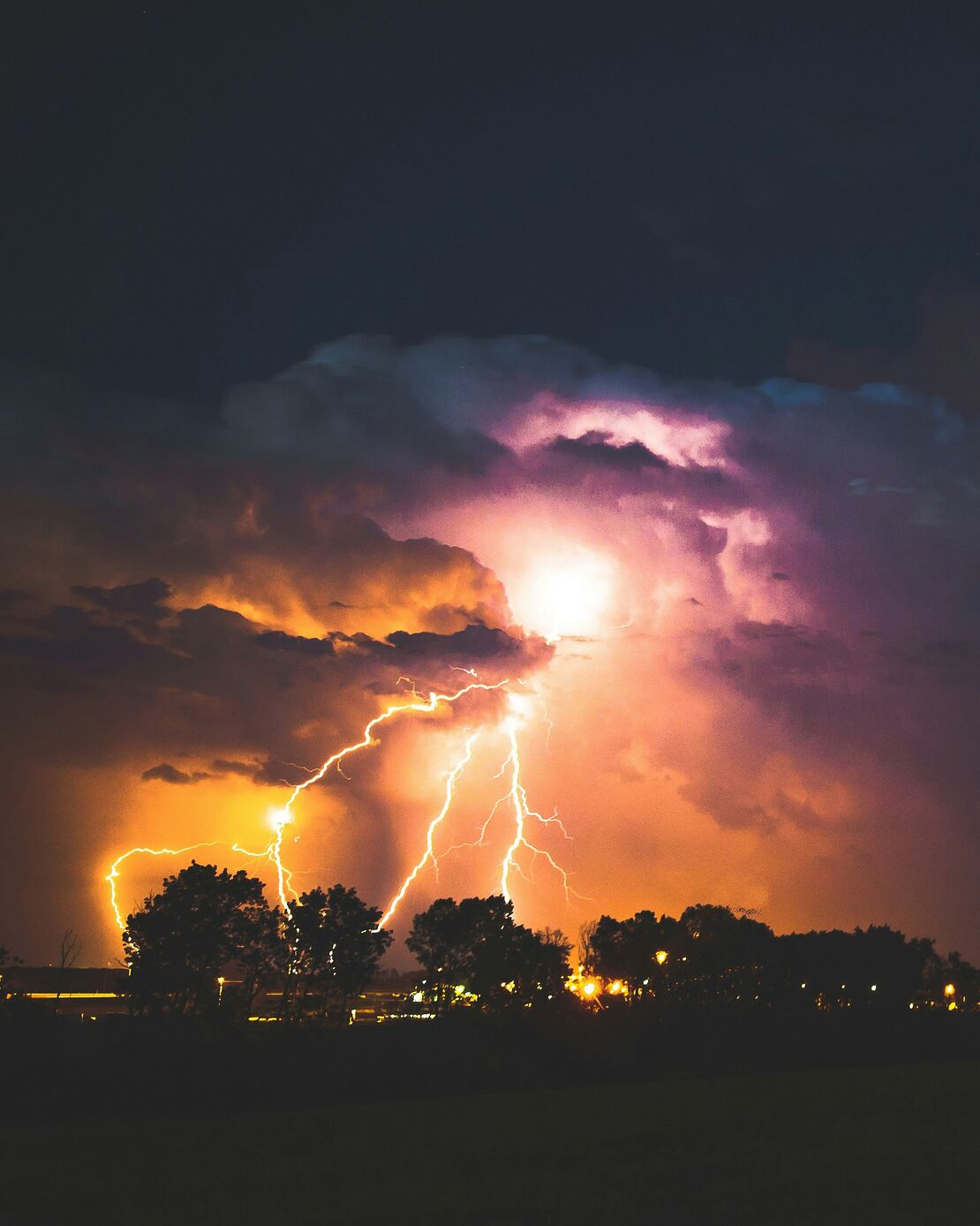
The phrase קוֹל יְהוָה appears seven times in this psalm (vv. 3a, 4ab, 5a, 7, 8a, 9a). The word קוֹל can refer to thunder (pl. קֹלֹות in Exod 9:23, 29, 33f; 19:16; 20:18; 1 Sam 12:17f; sg. קוֹל associated with "thunder" [רעם] in 1 Sam 7:10; Isa 29:6; Ps 18:14=2 Sam 22:14; Ps 77:19; 104:7; Job 37:4). In Ps 29, this association with thunder is made explicit; the first appearance of the phrase in v. 3a is followed by "the glorious God has thundered" (v. 3b). Other verses in the psalm allude to thunder (e.g., "lightning" in v. 7; deer giving birth in v. 9).
Effect
Structural: the use of קוֹל יְהוָה binds vv. 3-9 together as the body of the psalm, framed by an introduction (vv. 1-2) and conclusion (vv. 10-11).
Poetical: The seven-fold repetition of קוֹל יְהוָה (lit.: "the sound of YHWH" or "the voice of YHWH") sounds like seven peals of thunder booming throughout the psalm (cf. Rev 10:4).
Polemical: The Canaanite god Baal was associated with thunder. E.g., "Ba'lu emits his holy voice, Ba'lu makes the thunder roll over and over again. His [holy] voice [causes] the earth [to tremble], [at his thunder] the mountains shake with fear."[1] Another text associates Baal's lightning and thunder with the number seven: "Seven lightnings (he had), Eight storehouses of thunder were the shafts of (his) lightnings."[2] The seven thunders of YHWH in Ps. 29 demonstrate his superiority over Baal.[3]
Strength
If an emendation or revocalization is preferred, that emendation or revocalization will be marked in the Hebrew text of all the visuals.
| Emendations/Revocalizations legend | |
|---|---|
| *Emended text* | Emended text, text in which the consonants differ from the consonants of the Masoretic text, is indicated by blue asterisks on either side of the emendation. |
| *Revocalized text* | Revocalized text, text in which only the vowels differ from the vowels of the Masoretic text, is indicated by purple asterisks on either side of the revocalization. |

Feature
The body of the psalm (vv. 3-9) is framed by four lines on either side of it (vv. 1-2; vv. 10-11). In both vv. 1-2 and vv. 10-11, the name "YHWH" appears four times (once in each line), and the word "strength" (עֹז) appears once. In the first verse of the psalm (v. 1), the divine beings are summoned to "ascribe (lit.: 'give' יהב)... strength to YHWH." In the last verse of the psalm (v. 11), YHWH is said to "give (נתן) strength to his people." The psalm thus begins and ends with the giving of "strength."
Effect
The fact that the word "strength" frames the poem suggests that the poem is about "strength." Verses 3-9 may be summarized as a demonstration of YHWH's strength. The introduction and conclusion draw out the implications of YHWH's strength. Because YHWH is strong, all other gods ought to worship him (v. 1). And, because YHWH is strong, his people, who share in his strength, can rest secure (v. 11).
More and More
If an emendation or revocalization is preferred, that emendation or revocalization will be marked in the Hebrew text of all the visuals.
| Emendations/Revocalizations legend | |
|---|---|
| *Emended text* | Emended text, text in which the consonants differ from the consonants of the Masoretic text, is indicated by blue asterisks on either side of the emendation. |
| *Revocalized text* | Revocalized text, text in which only the vowels differ from the vowels of the Masoretic text, is indicated by purple asterisks on either side of the revocalization. |

Feature
Several verses in the psalm (vv. 1-2, 3, 5, 8, 10) exhibit a unique pattern called "staircase parallelism."[4] The pattern appears in its simplest form in vv. 3, 5, 8 – ABC//BCD. The first word of the a-line (ABC) is omitted in the b-line which adds a new word at the end of the line to compensate for the loss and expand the meaning of the verse (BCD). In vv. 1-2 and in v. 10, the pattern is slightly different and more complex. Outside of Ps 29, this this pattern is especially prominent in the Song of Deborah (Judges 5) and the Song of the Sea (Exod 15), as well as Ugaritic epics.[5]
Effect
The basic effect of this pattern is "to increase tension in the listener."[6]. In Ps 29, the pattern also has a structural effect. Each of the five strophes in the psalm opens with some form of this pattern (vv. 1, 3, 5, 8, 10). This is consistent with the fact that elsewhere this pattern appears at the beginning of poems or sections within a poem (e.g., Gen 49:22; Num 24:3; Judg 5:3, 12; Eccl 1:2).[7] The pattern may also be associated with a particular genre: that of the victory song (cf. Judges 5; Exodus 15). If so, then the pattern gives Ps 29 a triumphant feel. It may that Ps 29 functioned at one time as a victory song (cf. Story Behind of Psalm 29).
Repeated Roots
The repeated roots table is intended to identify the roots which are repeated in the psalm.
| Repeated Roots legend | |
|---|---|
| Divine name | The divine name is indicated by bold purple text. |
| Roots bounding a section | Roots bounding a section, appearing in the first and last verse of a section, are indicated by bold red text. |
 |
Roots occurring primarily in the first section are indicated in a yellow box. |
 |
Roots occurring primarily in the third section are indicated in a blue box. |
 |
Roots connected across sections are indicated by a vertical gray line connecting the roots. |
 |
Section boundaries are indicated by a horizontal black line across the chart. |
.jpg)
- There is a very high degree of lexical repetition in this psalm; 16 words/roots are repeated, and some of these are repeated more than once.
- The word קול ("voice") appears 7 times, each time as part of the phrase קול יהוה.
- Verses 3-9 are distinguished by the sevenfold use of קול; these verses are also bound (inclusio) by occurrences of the word כבוד in v. 3 and v. 9.
- The divine name (YHWH) appears 18 times.
- The name appears 10x within vv. 3-9 (distinguished by repetition of קול)
- The name appears 4x on either side of vv. 3-9; 4x in vv. 1-2 and 4x in vv. 10-11.
- The name appears in every verse except for v. 6.
- Much of the root repetition is short range and takes place in consecutive lines or verses
- יהב (vv. 1ab-2a)
- כבוד (vv. 1b-2a)
- מים (v. 3ac)
- שבר (v. 5ab)
- ארז (v. 5ab)
- לבנון (vv. 5b-6a)
- חיל (vv. 8ab-9a)
- מדבר (v. 9ab)
- ישב (v. 10ab)
- עם (v. 11ab)
- The psalm begins and ends (inclusio) with the giving (יהב / נתן) of עז ("strength") (vv. 1, 11). The divine beings are called to "give" (="ascribe") "strength" to YHWH who "gives" "strength" to his people.
Bibliography
- Albright, W. F. 1950. “A Catalogue of Early Hebrew Lyric Poems (Psalm Lxviii).” Hebrew Union College Annual 23 (1): 1–39.
- Andersen, Francis I. and Freedman, David Noel. 1980. Hosea: A New Translation with Introduction and Commentary. Volume 24 of the Anchor Bible series. New Haven, CT: Yale University Press.
- Baethgen, Friedrich. 1904. Die Psalmen. Göttingen: Vandenhoeck und Ruprecht.
- Barbiero, Gianni. 2016. "The Two Structures of Psalm 29". In Vetus Testamentum 66, 3: 378-392.
- Basevi, Claudio. 1990. “El Salmo 29: Algunas Observaciones Filógicas Sobre El Texto Hebreo y Griego.” Scripta Theologica 22 (January):13–47.
- Briggs, Charles A., and Emilie Briggs. 1906. A Critical and Exegetical Commentary on the Book of Psalms. Vol. 1. ICC. Edinburgh: T & T Clark.
- Calvin, John. Commentary on the Book of Psalms. Translated by James Anderson. Grand Rapids: Christian Classics Ethereal Library.
- Cohen, Chaim. 2004. "The Enclitic-mem in Biblical Hebrew: Its Existence and Initial Discovery." Pages 231-260 in Sefer Moshe: The Moshe Weinfeld Jubilee Volume: Studies in the Bible and the Ancient Near East, Qumran, and Post-Biblical Judaism. Edited by Chaim Cohen, Avi M. Hurvitz and Shalom M. Paul. University Park, USA: Penn State University Press.
- Cook, John. 2013. “Aspect: Pre-Modern Hebrew.” In EHLL, 1:201–5. Brill.
- Craigie, Peter C. 1983. Psalms 1–50. WBC 19. Waco, TX: Word.
- Cross, Frank M. 1950. “Notes on a Canaanite Psalm in the Old Testament.” Bulletin of the American Schools of Oriental Research 117: 19–21.
- Dahood, Mitchell. 1966. Psalms. Vol. 1. Anchor Bible Commentary. New York: Doubleday.
- Day, John. 1979. “Echoes of Baal’s Seven Thunders and Lightnings in Psalm XXIX and Habakkuk III 9 and the Identity of the Seraphim in Isaiah VI.” Vetus Testamentum 29 (2): 143–51.
- Delitzsch, Franz. 1883. Biblical Commentary on the Psalms: Vol. 1. Translated by Eaton David. Vol. 1. New York: Funk and Wagnalls.
- Duhm, Bernhard. 1899. Die Psalmen. Mohr Siebeck.
- Eaton, John Herbert. 1967. Psalms. Torch Bible Paperbacks. London: S.C.M. Press.
- Ehrlich, Arnold B. 1905. Die Psalmen; neu übersetzt und erklärt. Berlin: Poppelauer.
- Emerton, John A. 1996. “Are There Examples of Enclitic mem in the Hebrew Bible?” Pages 321-338 in Texts, Temples, and Traditions: A Tribute to Menahem Haran. Edited by Michael V. Fox, Victor Avigdor Hurowitz, Avi M. Hurvitz, Michael L. Klein, Baruch J. Schwartz, and Nili Shupak. Winona Lake, Eisenbrauns.
- Ewald, Heinrich. 1880. Commentary on the Psalms. Vol. 1. London: Williams and Norgate.
- Fokkelman, J.P. 2003. Major Poems of the Hebrew Bible: At the Interface of Prosody and Structural Analysis (Vol 3: The Remaining 65 Psalms). Vol. 3. Studia Semitica Neerlandica. Van Gorcum.
- Futato, Mark D. 2009. "The Book of Psalms." In Cornerstone Biblical Commentary: The Book of Psalms, The Book of Proverbs. Vol 7. Carol Stream: Tyndale House Publishers.
- Garr, W. Randall. 2022. "The Cataphoric Pronoun in Biblical Hebrew," JSS 67, no. 2: 353–393.
- Ginsberg, H. L. 1935. “A Phoenician Hymn in the Psalter.” In Atti del XIX Congresso Internazionale degli Orientalisti, Roma, 23-29 Settembre 1935 (Rome: G. Bardi, 1938), 472–6.
- Goldingay, John. 2006. Psalms: Psalms 1-41. Vol. 1. BCOT. Grand Rapids: Baker Academic.
- Gordon, Cyrus H. 1965. Ugaritic Textbook: Grammar, Texts in Transliteration, Cuneiform Selections, Glossary, Indices. Rome: Pontifical Biblical Institute.
- Gunkel, Hermann. 1926. Die Psalmen. 4th ed. Göttinger Handkommentar Zum Alten Testament 2. Göttingen: Vandenhoeck & Ruprecht.
- Hengstenberg, Ernst W. 1869. Commentary on Psalms. Vol. 1. Edinburgh: T & T Clark.
- Hossfeld, Frank-Lothar, and Erich Zenger. 1993. Die Psalmen I: Psalm 1–50. Neue Echter Bibel. Würzburg: Echter.
- Hummel, Horace D. 1957. "Enclitic Mem in Early Northwest Semitic, Especially Hebrew." In Journal of Biblical Literature; 76 (2): 85–107.
- Hupfeld, Hermann. 1855. Die Psalmen. Vol. 1. Gotha: Friedrich Andreas Perthes.
- Ibn Ezra. Ibn Ezra on Psalms.
- Kidner, Derek. 1973. Psalms 1-72: An Introduction and Commentary on Books I and II of the Psalms. London: Inter-Varsity Press.
- Kissane, Monsignor Edward J. 1953. The Book of Psalms: Translated from A Critically Revised Hebrew Text. Vol. 1. Maryland: The Newman Press.
- Kraus, Hans-Joachim. 1988. Psalms 1-59: A Commentary. Minneapolis: Augsburg.
- Loewenstamm, Samuel E. 1992. From Babylon to Canaan Studies in the Bible and Its Oriental Background. Jerusalem: The Magnes Press, The Hebrew University.
- May, Herbert G. 1955. “Some Cosmic Connotations of Mayim Rabbîm, ‘Many Waters.’” Journal of Biblical Literature 74 (1): 9–21.
- Niccacci, Alviero. 2006. “The Biblical Hebrew Verbal System in Poetry.” In Biblical Hebrew in Its Northwest Semitic Setting: Typological and Historical Perspectives, edited by Steven E. Fassberg and Avi Hurvitz, 247–68. Jerusalem: Hebrew University Magnes Press.
- Notarius. 2010. “The Active Predicative Participle in Archaic and Classical Biblical Poetry.” Ancient Near Eastern Studies 47: 241–269.
- Olshausen, Justus. 1853. Die Psalmen. Leipzig: S. Hirzel.
- Perowne, J. J. Stewart. 1870. The Book of Psalms: A New Translation, with Introductions and Notes Explanatory and Critical. London: Bell.
- Radak. Radak on Psalms.
- Ross, Allen P. 2011. A Commentary on the Psalms 1-41. Vol. 1. Grand Rapids: Kregel.
- Schenker, Adrian. 1994. “Gewollt Dunkle Wiedergaben in LXX? Am Beispiel von Ps 28 (29),6.” Biblica 75 (4): 546–55.
- Schwartz, Mark. 2018. “Warfare in the World of the Bible.” In Behind the Scenes of the Old Testament: Cultural, Social, and Historical Contexts, edited by Jonathan S. Greer, John W. Hilber, and John H. Walton, 506–14. Grand Rapids: Baker Academic.
- Shehadeh, Lamia R. 1991. “Lebanon in Ancient Texts.” In Quest for Understanding: Arabic and Islamic Studies in Memory of Malcom H. Kerr, 3–13. Beirut: American University of Beirut.
- Stec, David M., ed. 2004. The Targum of Psalms. The Aramaic Bible, v. 16. Collegeville, Minn: Liturgical Press.
- Tigay, Jeffrey H. 2008. "'The Voice of the Lord Causes Hinds to Calve' (Psalm 29:9)." Pages 399-411 in Birkat Shalom. Studies in the Bible, Ancient Near Eastern Literature, and Postbiblical Judaism Presented to Shalom M. Paul on the Occasion of His Seventieth Birthday. Ed. C. Cohen Et Al. Winona Lake, Indiana: Eisenbrauns.
- Watson, W. G. E. 1992. “Final -m in Ugaritic,” Aula Orientalis 10: 223-52.
- ________. 1994. “Final -m in Ugaritic Again,” Aula Orientalis 12: 95-103.
- ________. 1996. “Final -m in Ugaritic Yet Again,” Aula Orientalis 14: 259-68.
- ________. 2001. Classical Hebrew Poetry: A Guide to Its Techniques. London ; New York: T & T Clark.
Footnotes
- ↑ COS I:262-263.
- ↑ RS 24.245 lines 3b-4.
- ↑ See J. Day, “Echoes of Baal’s Seven Thunders and Lightnings in Psalm XXIX and Habakkuk III 9 and the Identity of the Seraphim in Isaiah VI,” VT 29, 1979.
- ↑ Watson 2001, 150-156.
- ↑ Cf. Albright 1950, 1-18. See also Ps 77:17; Hab 3.
- ↑ Watson 2001, 154
- ↑ Watson 2001, 154