Psalms That Sing
Welcome!
To the Psalms that Sing team, welcome to our Resource Site! This page is to explain the collaboration between our two teams to move in the direction of integrating our materials — your Guides and our exegetical materials.
Academic grounding
Psalms: Layer by Layer began with a vision for academically grounded yet accessible resources for the Bible translation world. The first step was the academic grounding, which we have now extensively developed.
Accessible to the translation world
The second step was to determine what it would look like for this material to be truly accessible to the translation world. In fits and starts, we've had trial materials, done a few workshops, and sought feedback to understand what would be most useful.
Over time, it has become clear that the method you, Psalms that Sing, have developed aligns most closely with our own vision: enabling teams to internalize a Psalm so well that they can bring it out naturally for any other context, both linguistically and culturally.
For that reason, it is with tremendous pleasure that we propose we integrate our materials into one guide, both for use in your workshops and for wider use in the Bible translation world.

Featured Workflow Guides
These are our first Translation Workflow guides that integrate the exegetical resources of Psalms: Layer by Layer with the guide format of Psalms that Sing.

"His Joyful Flock"
The Psalm 100 Guide represents the fullest integration of our materials, with Scriptura's Translation and Performance Notes fully included.

"Dwelling Together"
The Psalm 133 Guide shows a mid-level of integration, with Scriptura's Translation and Performance Notes available only as PDF.

"My King on Zion"
The Psalm 2 materials are the least integrated, not following the ten steps closely. It is available for comparison.
Hebrew Presentation
We are experimenting with different layouts of the text to achieve the purpose we've heard of a "Hebrew mirror."
This is a verse-by-verse layout, which would probably be needed to be adjusted to a line-by-line layout for the sake of width.
Verse 1
| Hebrew | Word | English |
|---|---|---|
| מִזְמ֥וֹר לְ תוֹדָ֑ה הָרִ֥יעוּ לַ֝ יהוָ֗ה כָּל־ הָ אָֽרֶץ׃ | 1 | A psalm for a thank offering. Shout joyfully to YHWH, all the earth! |
| מִזְמ֥וֹר לְ תוֹדָ֑ה הָרִ֥יעוּ לַ֝ יהוָ֗ה כָּל־ הָ אָֽרֶץ׃ | 2 | A psalm for a thank offering. Shout joyfully to YHWH, all the earth! |
| מִזְמ֥וֹר לְ תוֹדָ֑ה הָרִ֥יעוּ לַ֝ יהוָ֗ה כָּל־ הָ אָֽרֶץ׃ | 3 | A psalm for a thank offering. Shout joyfully to YHWH, all the earth! |
| מִזְמ֥וֹר לְתוֹדָ֑ה הָרִ֥יעוּ לַ֝ יהוָ֗ה כָּל־ הָ אָֽרֶץ׃ | 4 | A psalm for a thank offering. Shout joyfully to YHWH, all the earth! |
| מִזְמ֥וֹר לְתוֹדָ֑ה הָרִ֥יעוּ לַ֝ יהוָ֗ה כָּל־ הָ אָֽרֶץ׃ | 5 | A psalm for a thank offering. Shout joyfully to YHWH, all the earth! |
| מִזְמ֥וֹר לְתוֹדָ֑ה הָרִ֥יעוּ לַ֝ יהוָ֗ה כָּל־ הָ אָֽרֶץ׃ | 6 | A psalm for a thank offering. Shout joyfully to YHWH, all the earth! |
| מִזְמ֥וֹר לְתוֹדָ֑ה הָרִ֥יעוּ לַ֝יהוָ֗ה כָּל הָ אָֽרֶץ׃ | 7 | A psalm for a thank offering. Shout joyfully to YHWH, all the earth! |
| מִזְמ֥וֹר לְתוֹדָ֑ה הָרִ֥יעוּ לַ֝יהוָ֗ה כָּל־ הָ אָֽרֶץ׃ | 8 | A psalm for a thank offering. Shout joyfully to YHWH, all the earth! |
| מִזְמ֥וֹר לְתוֹדָ֑ה הָרִ֥יעוּ לַ֝יהוָ֗ה כָּל־הָ אָֽרֶץ׃ | 9 | A psalm for a thank offering. Shout joyfully to YHWH, all the earth! |
Verse 2
| Hebrew | Word | English |
|---|---|---|
| עִבְד֣וּ אֶת־יְהוָ֣ה בְּשִׂמְחָ֑ה בֹּ֥אוּ לְפָנָ֗יו בִּרְנָנָֽה׃ | 1 | Serve YHWH with joy! Enter before him with exultation! |
| עִבְד֣וּ אֶת ־יְהוָ֣ה בְּשִׂמְחָ֑ה בֹּ֥אוּ לְפָנָ֗יו בִּרְנָנָֽה׃ | 2 | Serve YHWH with joy! Enter before him with exultation! |
| עִבְד֣וּ אֶת־ יְהוָ֣ה בְּשִׂמְחָ֑ה בֹּ֥אוּ לְפָנָ֗יו בִּרְנָנָֽה׃ | 3 | Serve YHWH with joy! Enter before him with exultation! |
| עִבְד֣וּ אֶת־יְהוָ֣ה בְּ שִׂמְחָ֑ה בֹּ֥אוּ לְפָנָ֗יו בִּרְנָנָֽה׃ | 4 | Serve YHWH with joy! Enter before him with exultation! |
| עִבְד֣וּ אֶת־יְהוָ֣ה בְּשִׂמְחָ֑ה בֹּ֥אוּ לְפָנָ֗יו בִּרְנָנָֽה׃ | 5 | Serve YHWH with joy! Enter before him with exultation! |
| עִבְד֣וּ אֶת־יְהוָ֣ה בְּשִׂמְחָ֑ה בֹּ֥אוּ לְפָנָ֗יו בִּרְנָנָֽה׃ | 6 | Serve YHWH with joy! Enter before him with exultation! |
| עִבְד֣וּ אֶת־יְהוָ֣ה בְּשִׂמְחָ֑ה בֹּ֥אוּ לְ֝פָנָ֗י ו בִּרְנָנָֽה׃ | 7–8 | Serve YHWH with joy! Enter before him with exultation! |
| עִבְד֣וּ אֶת־יְהוָ֣ה בְּשִׂמְחָ֑ה בֹּ֥אוּ לְ֝פָנָ֗יו בִּרְנָנָֽה׃ | 9 | Serve YHWH with joy! Enter before him with exultation! |
| עִבְד֣וּ אֶת־יְהוָ֣ה בְּשִׂמְחָ֑ה בֹּ֥אוּ לְ֝פָנָ֗יו בִּ רְנָנָֽה׃ | 10 | Serve YHWH with joy! Enter before him with exultation! |
| עִבְד֣וּ אֶת־יְהוָ֣ה בְּשִׂמְחָ֑ה בֹּ֥אוּ לְ֝פָנָ֗יו בִּרְנָנָֽה׃ | 11 | Serve YHWH with joy! Enter before him with exultation! |
Verse 3
Words 1-5
| Hebrew | Word | English |
|---|---|---|
| דְּע֗וּ כִּֽי יְהוָה֮ ה֤וּא אֱלֹהִ֥ים | 1 | Acknowledge that YHWH, he is God. |
| דְּע֗וּ כִּֽי יְהוָה֮ ה֤וּא אֱלֹהִ֥ים | 2 | Acknowledge that YHWH, he is God. |
| דְּע֗וּ כִּֽי יְהוָה֮ ה֤וּא אֱלֹהִ֥ים הֽוּא | 3 | Acknowledge that YHWH, he is God. |
| דְּע֗וּ כִּֽי יְהוָה֮ ה֤וּא אֱלֹהִ֥ים | 4 | Acknowledge that YHWH, he is God. |
| דְּע֗וּ כִּֽי יְהוָה֮ ה֤וּא אֱלֹהִ֥ים | 5 | Acknowledge that YHWH, he is God. |
Words 6-18
Note that these have been separated out simply because the entire verse was too long to fit on one line.| Hebrew | Word | English |
|---|---|---|
| הֽוּא עָשָׂנוּ וְל֣וֹ אֲנַ֑חְנוּ עַמּ֗וֹ וְצֹ֣אן מַרְעִיתֽוֹ׃ | 6 | He has made us, and we are his, his people and the flock of his pasture. |
| הוּא עָשָׂ נוּ וְל֣וֹ אֲנַ֑חְנוּ עַמּ֗וֹ וְצֹ֣אן מַרְעִיתֽוֹ׃ | 7 | He has made us, and we are his, his people and the flock of his pasture. |
| הוּא עָשָׂ נוּ וְל֣וֹ אֲנַ֑חְנוּ עַמּ֗וֹ וְצֹ֣אן מַרְעִיתֽוֹ׃ | 8 | He has made us, and we are his, his people and the flock of his pasture. |
| הוּא עָשָׂנוּ וְ ל֣וֹ אֲנַ֑חְנוּ עַמּ֗וֹ וְצֹ֣אן מַרְעִיתֽוֹ׃ | 9 | He has made us, and we are his, his people and the flock of his pasture. |
| הוּא עָשָׂנוּ וְ ל֣ וֹ אֲנַ֑חְנוּ עַמּ֗וֹ וְצֹ֣אן מַרְעִיתֽוֹ׃ | 10-11 | He has made us, and we are his, his people and the flock of his pasture. |
| הוּא עָשָׂנוּ וְל֣וֹ אֲנַ֑חְנוּ עַמּ֗וֹ וְצֹ֣אן מַרְעִיתֽוֹ׃ | 12 | He has made us, and we are his, his people and the flock of his pasture. |
| הוּא עָשָׂנוּ וְל֣וֹ אֲנַ֑חְנוּ עַמּ֗ וֹ וְצֹ֣אן מַרְעִיתֽוֹ׃ | 13 | He has made us, and we are his, people and the flock of his pasture. |
| הוּא עָשָׂנוּ וְל֣וֹ אֲנַ֑חְנוּ עַמּ֗ וֹ וְצֹ֣אן מַרְעִיתֽוֹ׃ | 14 | He has made us, and we are his people and the flock of his pasture. |
| הוּא עָשָׂנוּ וְל֣וֹ אֲנַ֑חְנוּ עַמּ֗וֹ וְ צֹ֣אן מַרְעִיתֽוֹ׃ | 15 | He has made us, and we are his, and the flock of his pasture. |
| הוּא עָשָׂנוּ וְל֣וֹ אֲנַ֑חְנוּ עַמּ֗וֹ וְ צֹ֣אן מַרְעִיתֽוֹ׃ | 16 | He has made us, and we are his, the flock of his pasture. |
| הוּא עָשָׂנוּ וְל֣וֹ אֲנַ֑חְנוּ עַמּ֗וֹ וְצֹ֣אן מַרְעִיתֽ וֹ׃ | 17 | He has made us, and we are his, the flock of his pasture . |
| הוּא עָשָׂנוּ וְל֣וֹ אֲנַ֑חְנוּ עַמּ֗וֹ וְצֹ֣אן מַרְעִיתֽ וֹ׃ | 18 | He has made us, and we are his, the flock of his pasture. |
Psalm 100:1
This is an adaptation of a Reed-Kellogg diagram (with standard positions for subject, verb, modifiers, etc.) that conveys all the grammatical information of the Hebrew.
| Hebrew | Verse | English |
|---|---|---|
| מִזְמ֥וֹר לְתוֹדָ֑ה | 1a | A psalm for a thank offering. |
| הָרִ֥יעוּ לַ֝יהוָ֗ה כָּל־הָאָֽרֶץ׃ | 1b | Shout joyfully to YHWH, all the earth! |
SimpleGrammar
Fragment [v. 1]
    Nominal
      noun: מִזְמוֹר psalm
      Adjectival
        PrepositionalPhrase
          Preposition
            preposition: לְ for
          Object
            noun: תוֹדָה thanksgiving
  Fragment
    Vocative
      Nominal
            quantifier: כָּל all
            article: הָ the
            noun: אָרֶץ earth
    Clause
      Subject
      Predicate
        verb: הָרִיעוּ shout joyfully
        Adverbial
          PrepositionalPhrase
            Preposition
              preposition: לַ to
            Object
              noun: יהוָה YHWH
| Visualization | Description |
|---|---|
 |
The clause is represented by a horizontal line with a vertical line crossing through it, separating the subject and the verb. |
 |
The object is indicated by a vertical line that does not cross the horizontal line of the clause. Infinitives and participles may also have objects. If the direct object marker (d.o.m.) is present in the text, it appears in the diagram immediately before the object. If the grammar includes a secondary object, the secondary object will appear after the object, separated by another vertical line that does not cross the horizontal line of the clause. |
 |
The subject complement follows the verb (often omitted in Hebrew) separated with a line leaning toward the right. It can be a noun, a whole prepositional phrase or an adjective. The later two appear modifying the complement slot. |
 |
When a noun further describes or renames the object, it is an object complement. The object complement follows the object separated by a line leaning toward the right. |
 |
In a construct chain, the noun in the absolute form modifies the noun in the construct form. |
 |
Participles are indicated in whatever position in the clause they are in with a curved line before the participle. Participles can occur as nominal, where they take the place of a noun, predicate, where they take the place of a verb, or attributive, where they modify a noun or a verb similar to adjectives or adverbs. |
 |
Infinitives are indicated by two parallel lines before the infinitive that cross the horizontal line. Infinitive constructs can appear as the verb in an embedded clause. Infinitive absolutes typically appear as an adverbial. |
 |
The subject of the infinitive often appears in construct to it. In this situation, the infinitive and subject are diagrammed as a construct chain. |
 |
The object of the infinitive is indicated by a vertical line that does not cross the horizontal line of the infinitival clause. |
 |
Modifiers are represented by a solid diagonal line from the word they modify. They can attach to verbs, adjectives, or nouns. If modifying a verb or adjective, it is an adverb, but if modifying a noun, it is an adjective, a quantifier, or a definite article. If an adverb is modifying a modifier, it is connected to the modifier by a small dashed horizontal line. |
 |
Adverbials are indicated by a dashed diagonal line extending to a horizontal line. These are nouns or infinitives that function adverbially (modifying either a verb or a participle), but are not connected by a preposition. |
 |
Prepositional phrases are indicated by a solid diagonal line extending to a horizontal line. The preposition is to the left of the diagonal line and the dependent of the preposition is on the horizontal line. They can modify verbs (adverbial) or nouns (adjectival). |
 |
Embedded clauses are indicated by a "stand" that looks like an upside-down Y. The stand rests in the grammatical position that the clause fulfills. Extending from the top of the stand is a horizontal line for the clause. If introduced by a complementizer, for example כִּי, the complementizer appears before the stand. Embedded clauses can stand in the place of any noun. |
 |
When clauses are joined by a conjunction, they are compound clauses. These clauses are connected by a vertical dotted line. The conjunction is placed next to the dotted line. |
 |
Within a clause, if two or more parts of speech are compound, these are represented by angled lines reaching to the two compound elements connected by a solid vertical line. If a conjunction is used, the conjunction appears to the left of the vertical line. Almost all parts of speech can be compound. |
 |
Subordinate clauses are indicated by a dashed line coming from the line dividing the subject from the predicate in the independent clause and leading to the horizontal line of the subordinate clause. The subordinating conjunction appears next to the dashed line. |
 |
Relative clauses also have a dashed line, but the line connects the antecedent to the horizontal line of the relative clause. The relative particle appears next to the dashed line. |
 |
Sentence fragments are represented by a horizontal line with no vertical lines. They are most frequently used in superscriptions to psalms. They are visually similar to discourse particles and vocatives, but most often consist of a noun phrase (that does not refer to a person or people group) or a prepositional phrase. |
 |
In the body of the psalm, a horizontal line by itself (with no modifiers or vertical lines) can indicate either a discourse particle or a vocative (if the word is a noun referring to a person or people group). A discourse particle is a conjunction or particle that functions at the discourse level, not at the grammatical level. Vocatives can appear either before or after the clause addressed to them, depending on the word order of the Hebrew. |
 |
Apposition is indicated by an equal sign equating the two noun phrases. This can occur with a noun in any function in a sentence. |
| Hebrew text colors | |
|---|---|
| Default preferred text | The default preferred reading is represented by a black line. The text of the MT is represented in bold black text. |
| Dispreferred reading | The dispreferred reading is an alternative interpretation of the grammar, represented by a pink line. The text of the MT is represented in bold pink text, while emendations and revocalizations retain their corresponding colors (see below). |
| Emended text | Emended text, text in which the consonants differ from the consonants of the Masoretic text, is represented by bold blue text, whether that reading is preferred or dispreferred. |
| Revocalized text | Revocalized text, text in which only the vowels differ from the vowels of the Masoretic text, is represented by bold purple text, whether that reading is preferred or dispreferred. |
| (Supplied elided element) | Any element that is elided in the Hebrew text is represented by bold gray text in parentheses. |
| ( ) | The position of a non-supplied elided element is represented by empty black parentheses. For example, this would be used in the place of the noun when an adjective functions substantivally or in the place of the antecedent when a relative clause has an implied antecedent. |
| Gloss text colors | |
|---|---|
| Gloss used in the CBC | The gloss used in the Close-but-Clear translation is represented by bold blue text. |
| Literal gloss >> derived meaning | A gloss that shows the more literal meaning as well as the derived figurative meaning is represented in blue text with arrows pointing towards the more figurative meaning. The gloss used in the CBC will be bolded. |
| Supplied elided element | The gloss for a supplied elided element is represented in bold gray text. |
Grammatical explanation
SimpleGrammar
Fragment [v. 1]
    Nominal
      noun: noun fragment
      Adjectival
        PrepositionalPhrase
          Preposition
            preposition: preposition
          Object
            noun: object of preposition
  Fragment
    Vocative
      Nominal
            quantifier: quantifier
            article: article
            noun: (vocative) noun fragment
    Clause
      Subject
        noun: (elided subject)
      Predicate
        verb: verb
        Adverbial
          PrepositionalPhrase
            Preposition
              preposition: preposition
            Object
              noun: prepositional object
Translation & Performance Notes
The Translation & Performance Notes that Scriptura's field team has produced are found in Step 5 of the Workflow Guides, like this:
| מִזְמ֥וֹר לְתוֹדָ֑ה | 1 | A psalm for a thank offering. |
 | ||
| הָרִ֥יעוּ לַ֝יהוָ֗ה כָּל־הָאָֽרֶץ׃ | Shout joyfully to YHWH, all the earth! | |
| עִבְד֣וּ אֶת־יְהוָ֣ה בְּשִׂמְחָ֑ה | 2 | Serve YHWH with joy! |
| בֹּ֥אוּ לְ֝פָנָ֗יו בִּרְנָנָֽה׃ | Enter before him with exultation! | |
| דְּע֗וּ כִּֽי־יְהוָה ה֤וּא אֱלֹ֫הִ֥ים | 3 | Acknowledge that YHWH, he is God. |
| הֽוּא־עָ֭שָׂנוּ וְל֣וֹ אֲנַ֑חְנוּ | He has made us, and we are his, | |
| עַ֝מּ֗וֹ וְצֹ֣אן מַרְעִיתֽוֹ׃ | his people and the flock of his pasture. | |
| בֹּ֤אוּ שְׁעָרָ֨יו ׀ בְּתוֹדָ֗ה | 4 | Enter his gates with thanksgiving, |
| חֲצֵרֹתָ֥יו בִּתְהִלָּ֑ה | his courts with praise. | |
| הֽוֹדוּ־ל֝֗וֹ | Give thanks to him! | |
| בָּרֲכ֥וּ שְׁמֽוֹ׃ | Bless his name, | |
 | ||
| כִּי־ט֣וֹב יְ֭הֹוָה | 5 | for YHWH is good, |
| לְעוֹלָ֣ם חַסְדּ֑וֹ | his loyalty is forever, | |
| וְעַד־דֹּ֥ר וָ֝דֹ֗ר אֱמוּנָתֽוֹ׃ | and his faithfulness continues through generation after generation. | |
Legend
Key term, Name, Image, Figure of speech, Emotional language, Participant, Other word or phrase
Expanded Paraphrase
After the common pattern of facing danger, crying out to YHWH, and being helped by YHWH, the people of Israel went up to Jerusalem, to the temple, for a thanksgiving ceremony, including joyful songs of thanksgiving and praise and the presentation of a thank offering on the altar. The crowd, including the people, priests, and perhaps a leader or king, gathered outside the gates and began the ceremony with A psalm for a thank offering. A leader, perhaps a priest, begins by calling out to the great crowd, "Shout joyfully to YHWH in order to celebrate his kingship, all the earth! For his help and rescue demonstrates his good character, which is reason for not only Israel, but all the earth to praise him.
Notes
- The opening verse of Ps 100 contains important information for the psalm as a whole, and an important clue for understanding the psalm in its original setting:
- The superscription A psalm for a thank offering establishes the setting of the psalm (see below for more detail)
- The opening line (‘Shout joyfully…’) begins the chain of the psalm's 7 commands leading the audience into worship of YHWH.
- Although the psalm is probably addressed to Israel, this opening line shows a concern for everyone with its call to “all the earth.”[1]
- The phrase for a thank offering (לְתוֹדָה) probably refers to the presentation of a thank offering (known as a toda sacrifice) that was part of an Israelite thanksgiving ceremony. General theme thanksgiving and thanksgiving songs would also have been present for such moments.
- Modern versions render the Hebrew preposition לְ lǝ either as:
- a) “for understood as the purpose of the psalm. This is our preferred rendering. See ESV, NIV, NASB, BFC, PDV.
- b) Or “of” perceived as the content of the psalm. See NLT, HCSB, ASV, LSG).
- The term ‘thank offering’ may require the recipient to be made explicit in some languages. The context suggests that YHWH is the recipient: offering/giving/saying thanks to God.
- For more details on the superscription and its implications, see The Meaning of לְתוֹדָה in Ps 100:1.
- Modern versions render the Hebrew preposition לְ lǝ either as:
- The word rendered Shout joyfully (הָרִיעוּ) has as its core meaning the act of shouting or crying out loud.[2] Depending on the context, this verb can be used to describe two specific kinds of shouting:
- The gloss ‘shout joyfully’ thus captures both the shouting and the joyful elements.
- It is important also to emphasize that the word ‘shout joyfully’ is common in the celebration or crowning of a human king[6] or even of YHWH as king.[7]
- The translator or performer should make sure that his rendering captures this joyful celebration dimension.
- The phrase all the earth (כָּל־הָאָֽרֶץ) is interesting from at least two perspectives:
- First, it is a figure of speech and should not be interpreted literally.[8]
- Secondly, it is located at the end of the sentence in the Hebrew text, thus open to multiple interpretations:
- It could be a subtle poetic effect aiming at artistic beauty.
- This could produce a double interpretation where Israel, just as all the nations, are the addressee.
- It might finally aim at getting a harmonious line break.
- Or, lastly, the author of the psalmist might have all the above effects in view.
- The phrase has been interpreted in three main ways in modern translations::
- Option 1: Referring to all the land, focusing on a specific land/domain (specifically, all the land of Israel). See RSV and ASV.
- Option 2: Referring to all the earth, focusing on a universal/global spatial domain. See the vast majority of English versions. See also LBS: “ô terre tout entière” (“Oh all the earth” ).
- Option 3: Referring to all who dwell on the earth, focusing on the inhabitants of all the earth. This is the preferred version. Thus it also refers here to “all nations.”
- LSG: “Vous tous, habitants de la terre” (“All of you, inhabitants of the earth”); PDV: “Tous les habitants du monde” (“All the world's inhabitants”).
- For detailed analysis of this phrase see The Addressee of Ps 100. Although Israel is the real addressee, “all the earth” should be viewed as the “rhetorical” addressee. The psalmist has therefore, all humanity in view as he speaks, but is addressing the people of Israel as his real audience at the thanksgiving ceremony.
- The word order of the command ‘Shout joyfully to YHWH, all the earth!’ may be changed for other languages, notably beginning with the subject. For example, “you all (the people/nation of) the earth, shout joyfully to YHWH!”
- The preposition to (Hebrew ל) in the phrase ‘to YHWH’ indicates that YHWH is the one being praised/receiving the joyful shouts.
Expanded Paraphrase
Serve YHWH with joy in a posture of obedience to YHWH which comes not from fear but joyful service to a good and loyal master, who can be counted on to help his servants when trouble comes! All you gathered outside of YHWH's house and presence to give thanks, Enter before him into his house and his presence, to begin the thanksgiving ceremony with exultation to honor his rescue and give him the praise owed him by his people, when he cares for them!
Notes
- The verse contains two commands in the second person plural: ‘serve’ and ‘enter’. Both commands are addressed to Israel, just like the preceding command ‘shout joyfully’ found in verse 1.
- The first line ‘Serve YHWH with joy’ is all about joyful service. It combines the emotion of joy with the action serve (עִבְד֣וּ), which has connotations of work, submission, even slavery , as well as worship and devotion. The second line begins the concrete expression of this joyful service with the psalm's first invitation to enter joyfully (that is, with exultation) into YHWH's presence. The second invitation to enter into YHWH's presence is found in verse 4.
- The word translated here as serve (עבד) has a very rich range of meaning. Its primary meaning is connected to the general ideas of work and labour (for example, working the soil in Gen 2:5).[9] In this verse the meaning is entirely positive, calling Israel to serve/worship YHWH with joy. There are two options for rendering this verb:[10]
- Option 1: It may be understood as to work or labor in a general sense: ESV, HCSB, LBS. The command to serve is thus a call to obey just as a slave or servant is to obey and serve his master.
- Option 2: It may be understood from the perspective of people serving a deity and rendered as “worship”(NIV, NRSV, NLT). BFC has here “Offer him a joyful worship service.”[11]
- Le mot traduit par crier de joie (הָרִיעוּ) a pour sens fondamental l’action de crier ou de pousser un cri fort. Selon le contexte, ce verbe peut être utilisé pour décrire deux types spécifiques de cris :
- Le premier est le cri de guerre dans un contexte militaire, comme lors de la chute de la ville de Jéricho ou le cri de guerre d’Israël après que David ait tué Goliath.
- Le deuxième type de cris est celui des louanges joyeuses ou des « acclamations » dans le contexte du culte. C’est l’option préférée.
- La glose « crier de joie » fait ainsi ressortir à la fois les éléments « crier » et « joyeux ».
- Il est également important de souligner que l’expression « crier de joie » est courante dans la célébration ou le couronnement d’un roi humain ou même de YHWH en tant que roi.
- Le traducteur ou l’interprète doit s’assurer que sa traduction rend bien compte de cette dimension festive et joyeuse.
- The command to enter before him should be understood also as to “come into his presence” (ESV, NRSV, NET, NBS, LBS), notably in the Temple where he is believed to be present. “The phrase his presence refers specifically to the Temple, where Yahweh was present with his people.”[12]
- A possible rendering of the command is Enter/come (to the place/house/building) where he is (present).
Expanded Paraphrase
However, before entering to give thanks, let us establish the foundation of all our thanksgiving, beginning with a call to Acknowledge that YHWH, he and no other, none of the gods of the other nations who might compete, is God, the creator of all things. When he helped and rescued us, he showed himself superior over all other gods and powers! He, this great supreme God, made us, calling, redeeming, and forming us as a nation for himself, and therefore we are his, rightfully belonging to him, his people and the flock of his pasture whom he shepherds and cares for.
Notes
- The verse contains a single command in the second person plural: acknowledge (see NET, HCSB, PDV). It may also be understood as to recognize or confess (a statement or fact to be true)."[13] Likewise, some modern translations[14] utilize “know”:
- Some languages may require a “figurative expression” to capture the Hebrew verb, such as “Say ‘Yes’ in your heart” or “Put this word in your mouth.”[15]
- The conjunction ‘that’ (כִּי) introduces the statement and fact commanded to be acknowledged.
- BFC has here “know-this.”[16] This translation introduces the statement being acknowledged with a colon. Other languages may need to find creative ways to demonstrate the relationship between the verb ‘acknowledge’ and the statement being acknowledged.
- The sentence YHWH, he is God is the statement that people are called to acknowledge. This simple phrase has some important elements for the translator:
- The term God is generic, it thus refers to a deity in the most general sense. In contrast, YHWH is the personal and covenantal name of God.
- Translators should not interchange the two terms.
- The pronoun he refers to YHWH here:
- The construction ‘YHWH, he is God’ may seem strange in English. In Hebrew, the phrase emphasizes that YHWH alone, and no other god of the nations, is God.
- The translators and performers should seek to bring out this emphasis on YHWH’s unique status. This may be done through linguistic and/or non-linguistic devices.
- The verb make in the phrase he made us should not be interpreted to mean create in the sense of God creating humanity at the beginning of the world. Instead it refers to YHWH creating “a nation out of the slaves in Egypt, choosing them as his own people, a people who belonged to him alone.”[17] He thus called, redeemed, and formed them as a nation for himself.
- The translator or performer should avoid rendering the verb in such a way that it is understood as God creating the same way he did at the creation of the world.[18]
- The people to whom the command to ‘acknowledge’ is addressed are included in the first person plural pronouns ‘us’ and ‘we’. So, these are first plural inclusive pronouns here.
- The word and (ו) connects the phrase ‘He made us’ with the phrase ‘we are his’. Its explicit function is simply to coordinate the two clauses of the verse, but the semantic context implies that the term functions to indicate result.
- The translator may render the word ‘and’ here as therefore or with the result that. For example: YHWH created us, therefore = we are his.
- The phrase and we are his in Hebrew literally says and we are to him. This use of the preposition that most often means to (ל) is a standard way to indicate belonging, devotion, and commitment in Hebrew.[19]
- The phrase ‘we are his’ may be rendered as we belong to him.
- The phrase his people may be paraphrased as the people who belong to him.
- The phrase rendered the flock of his pasture has several important features for the translator:
- The notion of shepherding in general may be unknown for some cultures. Some modern cultures that know shepherding may do it quite differently from how it was done in Israel. The translator and performers would make sure their translation of terms like pasture or sheep will be understood and meaningful to their audience.
- A pasture (מַרְעִית) “is natural grassland, whether in a valley, on the slope of a hill, or in the wilderness where low-growing grasses flourish without the aid of human cultivation”[20] where domesticated animals are fed on grass.
- The phrase of his pasture is an image that means he takes care of or he cares for (BFC, PDV, NBS) the flock. Translators can consider this as a possible rendering to make the meaning clear.
- The flock is a group of animals assembled and herded together.[21]
- Many modern versions rightly render it as “(flock of) sheep” which is an acceptable translation choice.
- In contexts where flocks or (flock of) sheep are unknown or impossible to be used, translators or performers may opt for “people” for the reason that the people are compared here to a flock: The people whom he cares for.[22]
- The phrase ‘the flock of his pasture’ refers either to
- (1) the flock/sheep he pastures, that is, the sheep he leads to where they can feed
- (2) the flock/sheep that feed on his pasture (NBS)
- In contexts where flocks or (flock of) sheep are unknown or impossible to be used, translators or performers may opt for “people” for the reason that the people are compared here to a flock:
- “The people whom he cares for.”[23]
- The sentence ‘we are… the flock of his pasture’ should not be interpreted literally.
- It is a metaphor where the people of God are described as being the flock/sheep of the pasture of God.
- It may be necessary for some languages to make the comparison explicit by using a word such as “like” or “as”: “we are like the flock of his pasture”; “we are like the flock/sheep he cares for.”
- Some modern French versions renderings that may be of interest:
Expanded Paraphrase
He is our God and we are his people! We belong to him! With this foundation in mind, let us celebrate and give thanks for his help and rescue, as we Enter his gates with thanksgiving, his courts where his presence is most experienced with praise. Give thanks to him with joyful songs of thanksgiving and a thank-offering on the altar! Bless his name, speaking well of him and celebrating his character,
Notes
- This verse contains the final three commands of the psalm:
- The first command is a repeated invitation to enter, closely matching the call to enter in verse 2. The call to enter YHWH's gates and courts could have been sung immediately before, during, or after the congregation actually entered the temple complex to present their thanksgiving to YHWH.
- The final two imperatives are closely related as they call Israel to ‘give thanks’ and ‘bless YHWH's name’.
- It is likely no coincidence that Psalm 100 has seven commands guiding the audience into worship. This seven-verb chain can be displayed as follows:

- The notion of gates and courts are probably unknown to many cultures. To understand the call to enter YHWH's gates and courts, it is helpful to know the layout of the ancient Temple in Jerusalem:
- In the Old Testament, a court normally refers to a large rectangular space or yard within the walls surrounding the tabernacle or Temple. Worshippers gathered and made sacrifices in the court.[26] There were three main areas: (1) the temple building, (2) the inner court, and (3) the outer court.
- The temple building was separated into 2 rooms. The innermost room was the holy of holies, and it contained the Ark of the Covenant. The outer room (1 Kgs. 6; 2 Chron. 3) contained the altar of incense, the table for the bread, and the lampstands (1 Kgs. 7; 2 Chron. 4).
- Surrounding the temple building was the inner court, which contained the water basins and the bronze altar for sacrifices (1 Kgs. 7; 2 Chron. 4). There would have been gates leading from the outer court into this inner court (Ezek. 8:16), and the inner court was probably higher than the outer court, with stairs leading up to it. Thus it is also sometimes called the “upper court” (Jer. 36:10).
- It is much more likely that it is the Temple gates and not the city gates.[27] The best way to translate the term here is to use a rendering that does not make it specific as to the Temple or the city gates. If this option is not possible, the translator or performer can translate as the Temple gates. In this last option, the translation team could add a footnote explaining that another possible rendering is the city gates.
- The outer court surrounded the inner court, but was still a holy space where cultic activity took place.
- Thus, the phrases ‘his gates’ and ‘his courts’ describe things all belonging to the Temple. They should be understood and may be paraphrased as:
- the gates of his Temple and the courts of his Temple or
- the gates of God/YHWH’s Temple and the courts of God/YHWH’s Temple
- The prepositional phrase with thanksgiving describes the attitude expected from worshippers as they enter the gates.
- It may be rendered using the verb to give thanks: “as you are giving him thanks…”
- The prepositional phrase with praise describes the attitude expected from worshippers as they enter the courts.
- It may be rendered using the verb to praise: “as you are praising him…”
- One of the most central components of the key word bless (בָּרֲכ֥וּ) is that of “speaking well of” another.[28]
- In this verse the addressees are called upon to bless YHWH by celebrating and speaking of YHWH's goodness (verse 5a), loyalty (verse 5b), and faithfulness (verse 5c).
- In the Hebrew Bible, blessing YHWH is almost always intertwined with thankfulness and praise, as seen here with the call of הוֹדוּ (give thanks/praise) in the preceding clause.
- For many cultures, a literal rendering of bless in the local language will not correspond to the meaning of the Hebrew verb to bless here. For example, some cultures do not allow an inferior to bless a superior, as it is the case here. In other cultures, blessing always carries connotations of promising or giving material benefits to someone else. In verse 4, the meaning of ‘bless’ is closer to praise: see HCSB, NET, and NIV. Translators and performers should make sure the local term does not mean that the speaker is promising or giving material gifts to YHWH, or that the speakers are somehow superior to YHWH.
- The expression to bless someone’s name should not be interpreted literally. It is a figure of speech (called metonymy) where a person is referred to as his name.
- If a literal rendering of ‘bless his name’ is not possible or understandable in the local language, translators and performers may consider the renderings bless him or bless YHWH.
- LBS “louez-le [lit. praise-him]”; BFC “louez le Seigneur [lit. praise the Lord].”
- The general emotion of the verse is that of gratitude.
- The performance of the verse may be very effective as it is organized around the three main commands: to enter, to give thanks, and to bless.

Expanded Paraphrase
invoking the phrase associated with thank offerings: for YHWH is good to his people, Israel, his loyalty to his people, Israel, is forever, and his faithfulness to his people, Israel continues through generation after generation." The people then enter through the gates and into the temple courts and a thank-offering is offered on the altar, accompanied by joyful songs of thanksgiving and praise.
Notes
- This closing verse of the psalm provides the reasons for everything preceding it.
- It explains why Israel should be motivated to:
- shout joyfully and serve YHWH with joy (verse 1-2),
- joyfully enter his presence (verses 2, 4),
- acknowledge who he is and celebrate their covenantal relationship to him (verse 3),
- and give thanks to him and bless his name (verse 4).
- The conjunction for that begins verse 5 introduces three reasons for all the preceding commands of verses 1-4. Each of these reasons contains a Hebrew word order that emphasizes their quality:
- Verse 5a: YHWH’s character is good,
- Verse 5b: the duration of YHWH's loyalty is forever,
- Verse 5c the duration (and possibly also recipients) of YHWH's faithfulness continues through generation after generation).
- The first reason is the declaration that YHWH is good.
- For languages where the adjective good cannot be used for humans, translators or performers may paraphrase the declaration as:
- “YHWH is a good person.”
- “YHWH does (what is) good (to his people).”
- This affirmation was one of the most common refrains in Israel's worship.[29] Therefore, translators should make sure that the rendering of this phrase is harmonised throughout the Old Testament.
- The second reason supporting the commands of verses 1-4 is ‘his loyalty is forever.’
- The word for ‘loyalty’ (חֶסֶד) refers to YHWH's faithful commitment to fulfill his covenantal obligations towards his people, even when they themselves are unfaithful.[30]
- This loyalty stretches all the way back through Israel's history (from the example we have in the exodus from Egypt), and stretches forward into “forever.”
- The expression forever refers to something that is everlasting or has no ending.
- The third reason supporting the commands of verses 1-4 is that ‘his faithfulness continues through generation after generation.’
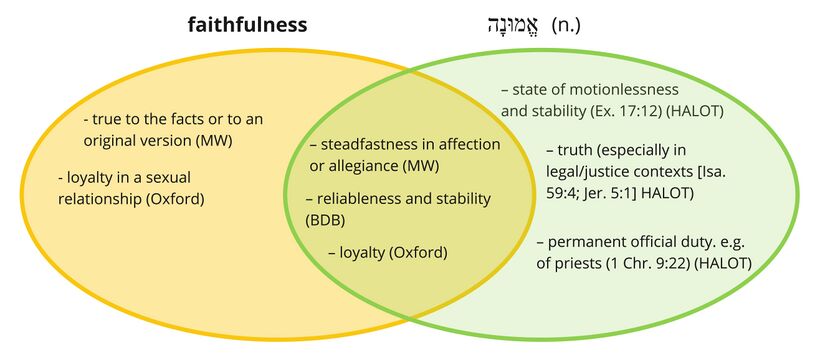
- The word faithfulness (אֱמוּנָה) implies a “state in which humans and deities are considered worthy of trust, because they are truthful and committed, with an unwavering disposition, which is reflected in their actions”.[31]
- The English word faithfulness is very close to, but not exactly the same as, the Hebrew word אֱמוּנָה. See the illustration below for a more detailed look at the Hebrew understanding of the root word (green circle on the right), our modern English understanding of the idea (yellow circle on the left), and what the two understandings have in common (the middle section where the two circles intersect):
- ‘His faithfulness’ has a direct link with the way a person can trust him.
- Verse 5 may be seen as having either two or three poetic lines. The preferred option is the former. For more details, see our verse by verse notes.
- In terms of meaning, the expression through generation after generation is similar to ‘forever’ because both refer to an unending reality.
- A generation is a group of people having lived in the same period of time. For example, children, grandchildren and parents belong to three different generations.
- For languages where it is not possible to have a literal translation of the expression ‘from generation to generation’, translators may simply use the expression they used earlier for ‘forever.’

- ↑ See notes on participant analysis/addressee for detailed notes on whether this psalm as a whole is addressed to Israel, to all nations, or to both.
- ↑ HALOT.
- ↑ Josh. 6:10, 16, 20.
- ↑ 1 Sam. 17:52.
- ↑ This usually occurs with the preposition ל and is very common throughout the psalms (e.g. Ps. 47:2; 66:1; 81:2; 95:1; 98:4). The joyful and worshipful nature of this shouting is clarified further with רוע rwʿ being paralleled or joined with רִנָּה rinnâ (joyful shouting/singing Ps. 47:2), זמרו zmrw (singing Ps. 66:1), זְמִירוֹת zǝmîrôt (songs Ps. 95), and other words associated with singing, joy, gladness, praise, and thanksgiving.
- ↑ 1 Sam 10:24; Zech 9:9. Cf. 2 Kgs 11:12.
- ↑ Ps 47:2-3 and 98:6.
- ↑ For a detailed explanation of how this figure of speech works, specifically as a “rhetorical addressee”, see detailed explanation in speech act notes.
- ↑ This can be positive, negative, or neutral, depending on the reason, environment, or nature of the work. In the most negative cases, this word implies slavery, as in Israel's brutal slavery in Egypt (e.g. Exod 1:13), and in the most positive cases it implies joyful service to a good master.
- ↑ “The Hebrew word used here, a‘vad, can describe work or service in general, or refer to honoring Yahweh in formal worship” (Barry et al. 2016, Ps. 100:2).
- ↑ Offrez-lui un culte joyeux.
- ↑ Bratcher and Reyburn (1991, 853).
- ↑ Bratcher and Reyburn (1991, 853).
- ↑ ESV, NIV, NRSV, LSG, LBS, BFC.
- ↑ Bratcher and Reyburn (1991, 853).
- ↑ sachez-le:.
- ↑ Bratcher and Reyburn (1991: 853).
- ↑ However, this may still be subtly hinded as a possible secondary meaning in light of the ambiguity regarding who the addressee is (Israel / all nations). For further details see notes in participant analysis on the addressee of Psalm 100.
- ↑ It parallels exactly the ל preposition in Song of Songs 2:16, (“My beloved is mine [lit. to me] and I am his [lit. to him]”).
- ↑ (Beck 2011: 191).
- ↑ https://www.merriam-webster.com/dictionary/flock
- ↑ (Bratcher and Reyburn 1991: 853).
- ↑ (Bratcher and Reyburn 1991: 853).
- ↑ (Nous sommes) le troupeau dont il est le berger.
- ↑ Il est notre berger, nous sommes son peuple, son troupeau.
- ↑ (Richards 1999: 193).
- ↑ Some arguments in favor of the Temple gates rather than the city gates: 1) They are "HIS gates", the Lord's gates, which would imply they are part of HIS house, which is primarily the temple. 2) The psalm is most likely part of a thanksgiving ceremony (see story behind etc...) which would have taken place in the temple. 3) They are clearly ritual gates, part of a worship ceremony, and worship would have taken place most centrally in the temple.
- ↑ This applies both to God blessing humans and humans blessing God, as we have in this verse (Ps. 100:4). God blesses human beings by speaking well of them, thereby imparting “blessing” (good things) to them, and so they are “blessed” (בָּרוּךְ); human beings bless God by speaking well of him, attributing “blessing” (good qualities) to him, and so he is “blessed” (בָּרוּךְ)—i.e., praised and praiseworthy.
- ↑ For example, Ps. 118:1-4, 29; Jer. 33:11; Nah. 1:7; Ps 34:9; 135:3; 136.
- ↑ see SDBH.
- ↑ SDBH.