The Text and Meaning of Ps 24:4b
Back to Psalm 24 Home
Introduction
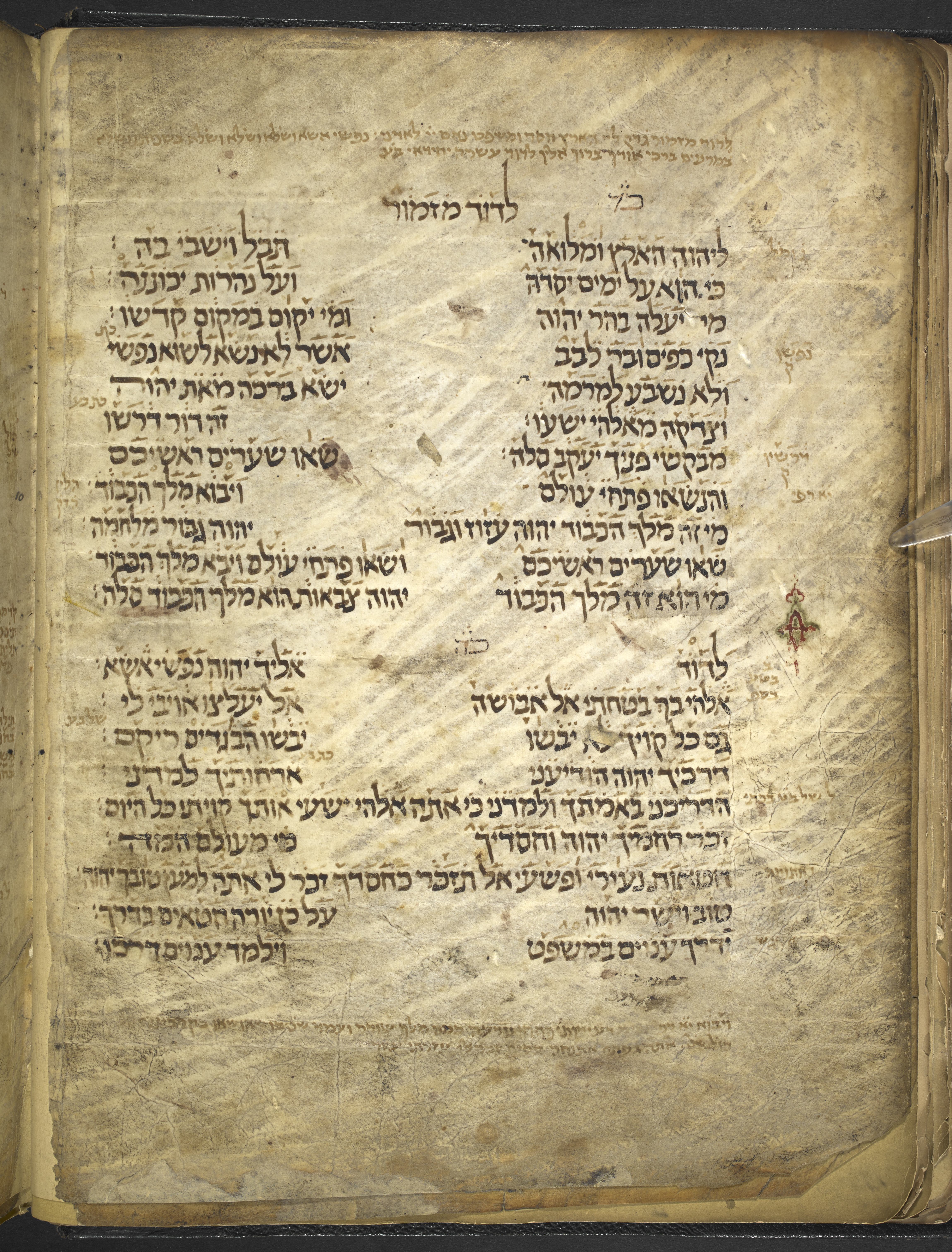
In response to the questions in Psalm 24:3, Who may go up on the mountain of YHWH? And who may stand in his holy place?, the Masoretic Text of v. 4, according to the Leningrad Codex, reads as follows:[1]
- נְקִ֥י כַפַּ֗יִם וּֽבַר־לֵ֫בָ֥ב
- אֲשֶׁ֤ר׀ לֹא־נָשָׂ֣א לַשָּׁ֣וְא נַפְשִׁ֑י
- וְלֹ֖א נִשְׁבַּ֣ע לְמִרְמָֽה׃
The second line is difficult on a couple of accounts. First, there is a textual issue with the word נַפְשִׁ֑י lit. "my soul," many witnesses attesting to *נַפְשׁוֹ* lit. "his soul." Compare, for example, the JPS and NASB:
- who has not taken a false oath by My life (JPS)
- who does not lift his soul to deceit (NASB)
Furthermore, the sense of the entire construction לָשֶׂאת נֶפֶשׁ לְ/אֶל, "to lift one's soul to something," has been interpreted as either swearing by or delighting in, as illustrated by the CEB and REB, respectively:[2]
- the one who hasn’t made false promises (CEB)
- who has not set his mind on what is false (REB)
Let us begin by establishing the text of נֶפֶשׁ before we analyze the construction לָשֵׂאת נֶפֶשׁ לְ/אֵל.
Argument Maps
The pronominal suffix נַפְשִׁי or נַפְשׁוֹ?
נַפְשׁוֹ (preferred)
Following the qere and ancient versions, most modern translations reflect נַפְשׁוֹ: "who does not lift up his soul to what is false" (ESV).
===
model:
    removeTagsFromText: true
    shortcodes:
      ":C:": {unicode: "🄲"}
      ":G:": {unicode: "🄶"}
      ":A:": {unicode: "🄰"}
      ":I:": {unicode: "🄸"}
      ":L:": {unicode: "🄻"}
      ":D:": {unicode: "🄳"}
      ":M:": {unicode: "🄼"}
selection:
    excludeDisconnected: false
dot:
    graphVizSettings:
        concentrate: true
        ranksep: 0.2
        nodesep: 0.2
===

[נַפְשׁוֹ]: The earliest form of the text probably read נַפְשׁוֹ.
 + <Ancient versions>: All the major ancient versions contain a 3ms suffix.
  + [Ancient versions]: LXX: τὴν ψυχὴν αὐτοῦ; Peshitta: ܒܢܦܫܗ; Jerome: animam suam; Targum: נַפְשֵׁיהּ.
 + <Hebrew Manuscripts>: נַפְשׁוֹ is found in some Hebrew manuscripts.
  + [Hebrew Manuscripts]: E.g., the base text of Kennicott 1776, 324 (cf. De Rossi 1788, 21-22; Ibn Ezra :C:; Radak :C:; Avishur 1996, 110 :C:). Several Cairo Genizah manuscripts read a 3ms suffix (Craigie 2004, 210 :C:), while Babylonian BL Or 2373 contains the qere נַפְשׁוֹ in the margin.
 + <Poetic structure>: Just as v. 3a and v. 4a contain considerable assonance (see בְהַר and וּבַר), the 3ms suffix at the end of v.4b creates end-rhyme with the last word of v. 3b, קָדְשׁוֹ.
נַפְשִׁי
Following the Leningrad Codex, some translations reflect נַפְשִׁ֑י: "who has not taken a false oath by My life" (JPS).
===
model:
    removeTagsFromText: true
    shortcodes:
      ":C:": {unicode: "🄲"}
      ":G:": {unicode: "🄶"}
      ":A:": {unicode: "🄰"}
      ":I:": {unicode: "🄸"}
      ":L:": {unicode: "🄻"}
      ":D:": {unicode: "🄳"}
      ":M:": {unicode: "🄼"}
selection:
    excludeDisconnected: false
dot:
    graphVizSettings:
        concentrate: true
        ranksep: 0.2
        nodesep: 0.2
===

[נַפְשִֹׁי]: The earliest form of the text probably read נַפְשִׁי. #dispreferred
 + <Manuscripts>: The Leningrad Codex reads נַפְשִׁי, as do a number of manuscripts listed by Kennicott (1776, 324).#dispreferred
   <_ <Harmonization>: It is possible that an original 3ms suffix on נֶפֶשׁ was changed to a 1cs suffix as a harmonization towards well-known text of the Decalogue, referring to YHWH's "name" as "my soul."
    + [Exodus 20:7]: לֹ֥א תִשָּׂ֛א אֶת־שֵֽׁם־יְהוָ֥ה אֱלֹהֶ֖יךָ לַשָּׁ֑וְא ("You shall not misuse the name of the LORD your God," NIV).
 + <The לָשֵׂאת שֵׁם לְ/אֶל construction in the Decalogue>: The expression לָשֵׂאת שֵׁם לְ/אֶל occurs in the Decalogue, and this expression is very similar to the MT's לֹא־נָשָׂ֣א לַשָּׁ֣וְא נַפְשִׁ֑י in Psalm 24:4, so YHWH must be speaking in the current context, meaning "lift up my soul/name in vain" (Ḥakham 1979, 129 :C:; Jacobson & Tanner 2014, 250 :C:). #dispreferred
  - <The Object of לָשֵׂאת>: The sense of the construction with שֵׁם rather than נֶפֶשׁ communicates "utter" or "mention," which makes little sense in this context.
   + [The לָשֵׂאת שֵׁם collocation]: See, e.g., Ps. 16:4: וּֽבַל־אֶשָּׂ֥א אֶת־שְׁ֝מוֹתָ֗ם עַל־שְׂפָתָֽי.
  - <Name>: "The soul is not the name" (Baethgen 1904, 70 :C:).
  - <Active Participants>: YHWH does not speak in the first person at any point of Ps 24, so it is unlikely to be the case in this single clause in the midst of the description of the person who will stand in YHWH's holy place (v. 3).
The construction לָשֵׂאת נֶפֶשׁ לְ/אֵל
Swear
Some understand the construction לָשֵׂאת נֶפֶשׁ לְ/אֵל as to swear: "whoever does not swear by the name falsely."[3]
===
model:
    removeTagsFromText: true
    shortcodes:
      ":C:": {unicode: "🄲"}
      ":G:": {unicode: "🄶"}
      ":A:": {unicode: "🄰"}
      ":I:": {unicode: "🄸"}
      ":L:": {unicode: "🄻"}
      ":D:": {unicode: "🄳"}
      ":M:": {unicode: "🄼"}
selection:
    excludeDisconnected: false
dot:
    graphVizSettings:
        concentrate: true
        ranksep: 0.2
        nodesep: 0.2
===

[The לָשֵׂאת נֶפֶשׁ לְ/אֶל construction]: The construction לָשֵׂאת נֶפֶשׁ לְ/אֶל means "swear by something" (Saadia in Qafaḥ 1965, 92 :C:; Radak :C:). #dispreferred
 + <Amos 6:8>: The intended sense is that of Amos 6:8 (Saadia in Qafaḥ 1965, 92 :C:; Radak :C:).
  + [Amos 6:8]: נִשְׁבַּע֩ אֲדֹנָ֨י יְהוִ֜ה בְּנַפְשׁ֗וֹ "The Sovereign LORD has sworn by himself" (NIV). #dispreferred
  <_ <Syntactic constituents>: The passage in Amos 6:8 employs the verb נִשְׁבַּע—which is found in the line following our present passage (וְלֹ֖א נִשְׁבַּ֣ע לְמִרְמָֽה), but should not be read into the semantics of our present clause—as well as a בְּ preposition on נֶפֶשׁ (Kirkpatrick 1897, 129 :C:)
 + <Ancient versions>: This is how both the Peshitta and Targum Psalms render the construction.
  + [Ancient versions]: * Peshitta: "who does not take an oath falsely on himself" (Taylor 2020, 83); Targum: "who does not swear falsely making his soul guilty" (Stec 2004, 62).
Delight (preferred)
Some understand the construction לָשֵׂאת נֶפֶשׁ לְ/אֵל as to desire, delight in: "the person who does not delight in what is false" (ISV).
===
model:
    removeTagsFromText: true
    shortcodes:
      ":C:": {unicode: "🄲"}
      ":G:": {unicode: "🄶"}
      ":A:": {unicode: "🄰"}
      ":I:": {unicode: "🄸"}
      ":L:": {unicode: "🄻"}
      ":D:": {unicode: "🄳"}
      ":M:": {unicode: "🄼"}
selection:
    excludeDisconnected: false
dot:
    graphVizSettings:
        concentrate: true
        ranksep: 0.2
        nodesep: 0.2
===

[The לָשֵׂאת נֶפֶשׁ לְ/אֶל construction]: "The idiom “raised the mind” (v 4b) implies an attitude of adoration and worship" (Craigie 2004, 213 :C:; cf. Kirkpatrick 1891, 129 :C:; Briggs & Briggs 1906-7, 215 :C:; DCH :L:, NIDOTTE :D:; Witthoff 2021, 149 :M:).
 + [The לָשֵׂאת נֶפֶשׁ לְ/אֶל construction]: See further Deuteronomy 24:15; Hosea 4:8; Psalm 25:1, 86:4, 143:8; Proverbs 19:18 (see Appendix; cf. also Jer 22:27; 44:14).
 + <Discourse Context>: The construction לָשֵׂאת נֶפֶשׁ לְ/אֶל occurs again shortly after Psalm 24:4, in the following Psalm, where it unambiguously has the sense of "desire."
  + [Ps. 25:1]: אֵלֶ֥יךָ יְ֝הוָ֗ה נַפְשִׁ֥י אֶשָּֽׂא "To you, O Lord, I lift up my soul" (ESV).
Conclusion (A)
The yod in the נַפְשִׁי of the Leningrad Codex might have come about by assimilation to the Decalogue or by confusion with the similarly-formed letter waw in נַפְשׁוֹ and perpetuated by assimilation to the Decalogue. In light of the evidence of ancient translations and the ongoing ketiv/qere issue throughout medieval manuscripts, נַפְשׁוֹ is a much stronger reading.
The tendency to read the ketiv נַפְשִׁי has led some to consider the construction לָשֵׂאת נֶפֶשׁ לְ/אֶל as swear by, in analogy to Amos 6:8. Nevertheless, the syntax is significantly different, so should not influence the sense of the present construction. As discussed in Witthoff (2021, 149), the construction is best understood as desire, resulting in the translation he who has not delighted in falsehood.[4]
Research
Translations
Ancient Translations
- LXX: ὃς οὐκ ἔλαβεν ἐπὶ ματαίῳ τὴν ψυχὴν αὐτοῦ[5]
- "he who did not occupy his soul with what is vain."[6]
- Jerome (Hebr.): qui non exaltavit frustra animam suam
- "who did not lift up his soul in vain"
- Targum: דְלָא אוֹמֵי עַל שִׁקְרָא לְחַיָבָא נַפְשֵׁיהּ[9]
- "who does not swear falsely making his soul guilty."[10]
Manuscripts

Modern Translations
נַפְשִׁי
- who has not taken a false oath by My life (JPS)
נַפְשׁוֹ and swear
- the one who hasn’t made false promises (CEB)
- who has not appealed to what is false (CSB)
נַפְשׁוֹ and delight
- who has not set his mind on what is false (REB; cf. HCSB)
נַפְשׁוֹ and non-committal
- who does not lift his soul to deceit (NASB) / vanity (KJV) / falsehood (ASV) / what is false (ESV)
- der seine Seele nicht auf Falsches gerichtet (ELB)
Secondary Literature
- Avishur, Yitzhak. 1996. "Psalm 24." Pages 108-111 in Psalms: Volume 1. Olam HaTaNaKh (Hebrew; תהלים א׳ עולם התנ׳׳ך). Tel Aviv: דודזון–עתי.
- Baethgen, Friedrich. 1904. Die Psalmen: übersetzt und erklärt. Göttingen: Vandenhoeck & Ruprecht.
- Briggs, Charles A. & Briggs, Emilie G. 1906-7. A Critical and Exegetical Commentary on the Book of Psalms, International Critical Commentary. New York: C. Scribner’s Sons.
- Craigie, Peter C. 2004. Psalms 1-50. Second edition. Nashville, TN: Nelson.
- Ḥakham, Amos. 1979. The Book of Psalms: Books 1-2 (Hebrew; ספר תהלים: ספרים א–ב). Jerusalem: Mossad Harav Kook.
- Ibn Ezra. Ibn Ezra on Psalms.
- Jacobson, Rolf A. & Tanner, Beth. 2014. "Book One of the Psalter: Psalms 1–41," in The Book of Psalms (NICOT). Grand Rapids, MI; William B. Eerdmans Publishing Company.
- Kirkpatrick, Alexander, F. 1891. Psalms with Introduction and Notes. Cambridge: Cambridge University Press.
- Radak. Radak on Psalms.
- Saadia = Qafaḥ, Yosef. 1965. The Psalms with Translation and Commentary of Saadia Gaon (in Hebrew: תהלים עם תרגום פוירוש הגאון). Jerusalem: The American Academy for Jewish Research (האקדימיה האמריקאנית למדעי היהדות).
- Witthoff, David J. 2021. The Relationships of the Senses of נְפֶשׁ in the Hebrew Bible: A Cognitive Linguistic Perspective. PhD dissertation, University of Stellenbosch.
Appendix: Other instances of לָשֵׂאת נֶפֶשׁ לְ/אֶל
- וְאֵלָ֕יו ה֥וּא נֹשֵׂ֖א אֶת־נַפְשׁ֑וֹ (Deut 24:15)
- חַטַּ֥את עַמִּ֖י יֹאכֵ֑לוּ וְאֶל־עֲוֺנָ֖ם יִשְׂא֥וּ נַפְשֽׁוֹ׃ (Hos 4:8)
- לְדָוִ֡ד אֵלֶ֥יךָ יְ֝הוָ֗ה נַפְשִׁ֥י אֶשָּֽׂא׃ (Ps 25:1)
- שַׂ֭מֵּחַ נֶ֣פֶשׁ עַבְדֶּ֑ךָ כִּ֥י אֵלֶ֥יךָ אֲ֝דֹנָ֗י נַפְשִׁ֥י אֶשָּֽׂא׃ (Ps 86:4)
- הַשְׁמִ֘יעֵ֤נִי בַבֹּ֨קֶר׀ חַסְדֶּךָ֮ כִּֽי־בְךָ֪ בָ֫טָ֥חְתִּי הוֹדִיעֵ֗נִי דֶּֽרֶךְ־ז֥וּ אֵלֵ֑ךְ כִּֽי־אֵ֝לֶיךָ נָשָׂ֥אתִי נַפְשִֽׁי׃ (Ps 143:8)
- יַסֵּ֣ר בִּ֭נְךָ כִּי־יֵ֣שׁ תִּקְוָ֑ה וְאֶל־הֲ֝מִית֗וֹ אַל־תִּשָּׂ֥א נַפְשֶֽׁךָ׃ (Prov 19:18)
Reference
24:4 Approved
- ↑ Text from OSHB.
- ↑ Many translations maintain the form of the idiom without communicating its meaning, such as the ESV: "who does not lift up his soul to what is false." Further, the possibilities of "who does not trust in an idol" (NIV) or "don't worship idols" (CEV) seem to be contextual guesses, rather than following the sense of the Hebrew construction.
- ↑ Saadia Gaon, מן לם יחלף באלאסם זורא (Qafaḥ 1965, 92).
- ↑ It is worth noting the semantic range of שָׁוְא, though it does not affect the conclusions of the present exegetical issue. Consider the following Venn diagram:
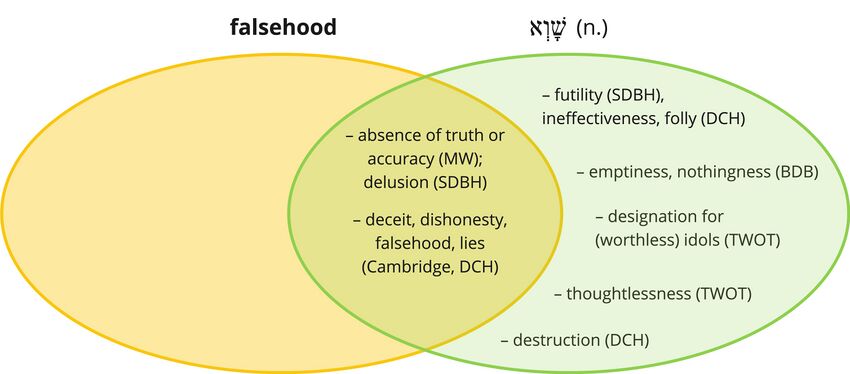 The connection between unreal and therefore both false and useless is easily traced, while idols can provide a real-world substantiation of either of these two ideas. Which nuance, then, is being construed in this verse? Although there is much overlap in these English glosses, the idea of deceit, dishonesty, falsehood, lies (all DCH) seems preferable in light of the next line. Not only does this person not נָשָׂא נַפְשֹׁו לַשָּׁוְא, but he also does not swear deceitfully (וְלֹ֖א נִשְׁבַּ֣ע לְמִרְמָֽה׃). The so-called 'synthetic parallelism' contributes two different angles of the same conceptual idea across the two lines. Swearing deceitfully (v. 4c), i.e., agreeing to something and then doing the opposite, is the embodiment of delighting in falsehood in v. 4b.
- ↑ Rahlfs 1931, 113.
- ↑ NETS.
- ↑ CAL
- ↑ Taylor 2020, 83.
- ↑ CAL
- ↑ Stec 2004, 62.