Psalm 25/Verse-by-Verse
Welcome to the Verse-by-Verse Notes for Psalm 25!
The Verse-by-Verse Notes present scholarly, exegetical materials (from all layers of analysis) in a verse-by-verse format. They often present alternative interpretive options and justification for a preferred interpretation. The Verse-by-Verse Notes are aimed at consultant-level users.
The discussion of each verse of this psalm includes the following items.
- A link to the part of the overview video where the verse in question is discussed.
- The verse in Hebrew and English.[1]
- An expanded paraphrase of the verse.[2]
- A grammatical diagram of the verse, which includes glosses for each word and phrase.[3]
- A series of notes on the verse, which contain information pertaining to the interpretation of the psalm (e.g., meaning of words and phrases, poetic features, difficult grammatical constructions, etc.).
Introduction
Poetic Structure and Message
The meaning, or message, of a poem is often tied to its structure. This is especially true for Psalm 25. Psalm 25 has two complementary structures, and both are key to determining its meaning. First, it has an acrostic structure. Second, it has a three-part concentric structure, which highlights verse 11 as the center of the whole poem.[4] Together, these structures suggest that the discourse topic of the poem is hope, with particular attention given to the concept of forgiveness.
Acrostic structure: hope as discourse topic
Psalm 25 is an acrostic poem; each verse of the poem begins with a successive letter of the Hebrew alphabet. Verse 1 begins with alef (אֵלֶיךָ), verse 2 with bet (בְּךָ), verse 3 with gimel (גַּם), and so on. Like many biblical acrostics, however, Psalm 25 sometimes deviates from the expected alphabetic pattern. Before discussing the significance of the acrostic structure, it is necessary to address these apparent points of deviation.
Points of deviation from expected structure
There are five apparent points of deviation from the expected acrostic structure.
- According to the Masoretic Text, v. 2 begins with alef, not bet. Instead, bet second word of v. 2 begins with bet.
- There is no waw verse.
- There is an additional pe verse at the end of the poem (v. 22).
- There is no qof verse.
- There are two resh verses (vv. 18–19).
The first deviation (the bet verse) is probably due to a scribal error, preserved in the Masoretic Text. In the original poem, the first word of "v. 2" (אֱלֹהַי) was probably the last word of the alef verse, such that the bet verse does, in fact, begin with bet (בְּךָ). The first deviation, therefore, is only apparent. See the discussion on v. 1 below.
The next two deviations (no waw verse and additional pe verse) also occur in Psalm 34, which suggests an intentional and established pattern rather than scribal error.[5]
The last two deviations (no qof verse and two resh verses) are unique to Psalm 25, but they clearly contribute to the poem's artistry, implying deliberate design rather than scribal error. See The Missing Qof in Psalm 25:18 and the notes below for a detailed discussion. In short, the missing qof and the double resh (vv. 18–19) create a chiasm:
A. pe (v. 16)[6]
 B. hope and rescue (vv. 15, 17)
  C. double resh (vv. 18–19)
 B. hope and rescue (vv. 20–21)
A. pe (v. 22)
This chiasm that spans vv. 15–22 involves three of the deviations from the expected acrostic pattern: the double resh, the missing qof, and the additional pe at the end of the psalm. Without these deviations, there would be no chiasm. This suggests that the poet has deliberately diverged from the standard alphabetic structure to create a chiasm. The significance of this chiasm is discussed below, in connection with the three-part structure of the psalm and the focus on forgiveness.
Excursus: the order of pe (v. 16) and ayin (v. 15)
One other feature related to the acrostic structure merits discussion: the order of pe (v. 16) and ayin (v. 15). Most biblical acrostics have the now-standard ayin-pe order, while several biblical acrostics have the order pe-ayin (e.g., MT Lamentations 2, 3, 4; LXX Prov 31). Scribes sometimes updated the order of these verses to reflect their preferred sequence (compare, e.g., Lam 1 in MT [ayin-pe] and 4QLam [pe-ayin]; and Prov 31 in MT [ayin-pe] and LXX [pe-ayin]). There is good evidence to suggest that this kind of updating was applied to certain psalms as well, especially Psalm 34 and Psalm 37.[7] It is likely that these two psalms originally had a pe-ayin order, which was updated to ayin-pe (and the update is reflected in all of our witnesses). Given the structural similarities between Psalm 34 and Psalm 25 – both lack a waw verse and add a pe verse; both are also written by David – it would not be surprising if Psalm 25 also originally had a pe-ayin order.[8] Indeed, a pe-ayin order results in a beautiful poetic arrangement (see the chiasm discussed above). If the traditional ayin-pe order is adopted, then the chiasm (along with other structural features; see below) would be lost.[9]
Significance of the acrostic
The alphabet is a symbol of completeness.[10] In an acrostic poem, the poet takes a topic (e.g., Torah [Ps 119], or the virtuous woman [Prov 31]) and expounds on it completely (i.e., from every angle necessary to gain a sufficient understanding), so that the reader walks away with a high-resolution image of the topic (i.e., he/she understands it “from A to Z;” see also Pss 34, 37, 111, 112).
What, then, is the topic of Psalm 25? This is where some of the deviations from the expected acrostic become significant. In Psalm 25, only two letters are missing: qof and waw. Interestingly, these two letters are the two main consonants in the Hebrew word for "hope" (קוה).[11] This word occurs three times in Psalm 25 (vv. 3, 5, 21), which is more than in any other psalm. In addition to the three-fold use of the word "hope" (קוה), the theme of hope is present in several other verses (vv. 1–2, 15). In fact, expressions of hope (together with the related concept of "shame") help frame the psalm (vv. 1–3, vv. 20–21). This suggests that the discourse topic of Psalm 25 is hope: what does it look like to hope in YHWH in the midst of trouble?
(Click diagram to enlarge)

Three-part concentric structure: forgiveness as prominent theme
In addition to the acrostic structure, the psalm is arranged in three main sections that have a concentric structure: (1) alef—het (vv. 1–7); (2) tet—samek (vv. 8–14); (3) pe—tav+pe (vv. 16, 15, 17–22).[12] Each section contains seven letters of the acrostic, except for the last section, which has an additional letter (the final pe, hence: 7+1). Despite the extra letter in the final section, this section has the same number of lines as the first section: 16 lines. (The extra lines in vv. 5, 7 contribute to this balance.) The details of the psalm's poetic structure can be visualized as follows:
(Click diagram to enlarge)

The first section (vv. 1–7) and the third section (vv. 15–22) are, for the most part, addressed to YHWH in the second person.[13] In terms of speech acts, these sections are requests. These two outer sections are also approximately the same length (16 lines, 7[+1] acrostic letters).
The central section (vv. 8–14) is unique in that it is, for the most part, a description rather than a request, and it talks about YHWH in the third person. Verse 11 stands out as the central verse in this section. Not only is it the one verse in this section that addresses YHWH directly and presents a request, but it is also the center of an ABCXABC structure:
A (vv. 8, 12) = repetition of "instructs in the way" (יוֹרֶה בְּדֶרֶךְ)
B (vv. 9, 13) = yiqtol verbs, pronominal references to the previous verse, bet prepositional phrase, waw conjoined clauses, and a unique rhythm of 3/3 prosodic words
C (vv. 10, 14) = construct phrases with "YHWH," repetition of "his covenant"
X (v. 11) = direct address to YHWH
Thus, v. 11, a request for forgiveness, is at the very center of the psalm.[14] Verse 11 is also the center of the whole psalm in terms of line count, being preceded on either side by 22 lines (the number of letters in the alphabet!).
The third section (vv. 15–22) has a chiastic structure, as discussed above. The request for forgiveness (v. 18) is at the center of this structure.
The three-part poetic structure highlights the theme of forgiveness. Although forgiveness is only mentioned in two verses (vv. 11, 18b), these verses (especially v. 11) are located at central, prominent positions within the poem. The poem is clearly drawing attention to the theme of forgiveness.
(Click diagram to enlarge)

But why highlight forgiveness in this way, especially when the psalmist was facing the more immediate problem of violence from enemies (vv. 2b, 19)? Perhaps it is because the psalmist realized that the root of his problem was his sin, and, therefore, the deepest and ultimate solution to his problem was not rescue from his enemies but the forgiveness of his sin. The psalmist seems to have realized that his enemies were only a symptom of a deeper problem, namely, his sin (see esp. 2 Sam 7:14; 1 Kgs 2:1–4; Ps 89:20–38; cf. Deut 28; 32; etc.). As Calvin explains in his commentary on this psalm, "David, in order to obtain assistance from God, first acknowledges that God had justly made use of this as a means of chastising and punishing him for his sins; and, therefore, he prays for their forgiveness, that he may at once enjoy assurance of the divine favor, and obtain deliverance."[15]
By placing forgiveness at the center, the psalmist teaches those who hope in YHWH (see v. 3a) to view their troubles through a covenantal lens (see e.g., Deut 28). Covenant disobedience leads to many troubles. Therefore, if Israel is to be redeemed "from all their troubles" (v. 22), YHWH must forgive their sins (see Jer 31:31–34). Without the forgiveness of sins, there can be no true or lasting deliverance.
Coherence and Background
The structure of the poem, discussed in the previous section, helps us begin to see how the psalm's various themes relate to one another. For example, how does rescue from enemies (vv. 2b, 19) relate to the forgiveness of sins (vv. 11, 18b) and the request for guidance to walk in covenant faithfulness (vv. 4–5, 8–9)?
The issue can be brought into clearer focus by examining the psalm's semantic domains. Lohfink helpfully shows how the vocabulary of Psalm 25 can be organized into seven semantic domains (listed here according to frequency):[16]
- Enemies and rescue (16x): "enemy" (אויב), "shame" (בושׁ), "violence" (חמס), "trouble" (צרה), "act unfaithfully" (בגד), "net" (רשׁת), "redeem" (פדה), "rescue" (נצל), "bring out" (הוציא)
- God's attributes and work (15x): "mercy" (חנן), "loyalty" (חסד), "compassion" (רחם), "name" (שׁם), "faithfulness" (אמת), "guard" (שׁמר), "keep" (נצר), "remember" (זכר), "blameless" (תמם), "just" (ישׁר)
- Way and knowledge (13x): "way" (דרך), "pathway" (ארח), "show" (הראה), "teach" (למד), "instruct" (יורה)
- Poverty and humility (8x): "afflicted/lowly" (ענה), "hardship" (עמל), "lonely" (יחיד), "fear" (ירא), "possess" (ירשׁ)
- Sin and forgiveness (6x): "sin" (חטא), "rebellion" (פשׁע), "guilt" (עון), "forgive" (סלח)
- Covenant and commandment (5x): "covenant" (ברית), "testimony" (עדות), "justice" (משׁפט), "instruction" (תורה), "Israel" (ישׂראל)
- Trust and hope (5x): "take refuge" (חסה), "trust" (בטח), "hope" (קוה)
The psalmist's most urgent need is rescue from enemies. Because of his enemies, he is in a state of poverty and humility. But the root cause of his distress is his sin. His deepest need, therefore, is forgiveness and guidance in YHWH's ways. For all of these things, he places his trust and hope in YHWH alone, and he bases his expectation on YHWH's atributes and work.
The covenant domain is necessary to understand how all of the others fit together. YHWH made a covenant with David and his descendants. If David and his descendants walked in YHWH's ways, they would experience YHWH's loyalty and faithfulness (cf. Jer 22:3–5); but if they sinned and rebelled against YHWH, they would be punished (2 Sam 7:14; 1 Kgs 2:1–4; Ps 89:20–38). Similarly, YHWH made a covenant with Israel. If Israel walked in YHWH's ways, they would experience YHWH's loyalty and faithfulness (Exod 19:5–6; 20:6); but if they sinned and rebelled against YHWH, they would be punished (Exod 19–24; Deut 28).[17] Covenant disobedience, then, is the root cause of affliction from enemies. Thus, only when YHWH's people turn to him in repentance and learn to walk in his ways will he rescue them from their enemies.[18]
We can imagine the following series of background events as having taken place before the psalm was first recited.
(Click diagram to enlarge)

The full "story behind" Psalm 25 might be visualized as follows:
(Click diagram to enlarge)

The rising action, or tension, of the story includes the people's sin, affliction, and their turning to YHWH in hope. The climax of the story comes when YHWH, who is compassionate and merciful, turns toward his people and sees their affliction. Within the psalm itself, this event does not actually happen, but the psalmist wants it to happen. The psalmist also looks forward to a time when YHWH will forgive sins, teach his people to walk in his ways, and, in this way, rescue them from their enemies.
Allusion to Exodus 32–34
Psalm 25 has numerous linguistic and thematic correspondences to Exodus 32–34. These chapters describe the story of the golden calf, the renewal of the Sinai covenant, and the revelation of YHWH's character as a god who is "abounding in loyalty and faithfulness, forgiving guilt, rebellion, and sin" (Exod 34:6).
The two most prominent connections between Psalm 25 and Exodus 32–34 are as follows:
- The request "Show me your ways" (Ps 25:4; Exod 33:13). These are the only two verses in the Bible in which this precise request occurs (הוֹדִיעֵנִי + דְּרָכֶיךָ) (cf. Ps 103:7).
- The request "would you forgive my/our guilt" (Ps 25:11; Exod 34:9). These are the only two places in the Bible where the expression וְסָלַחתָּ לַעֲוֹן occurs (weqatal second person singular).
These two allusions to Exodus come at especially prominent points in Psalm 25. The request for forgiveness in v. 11 is the central request of the psalm (see above), and the word for "ways" (דרך) is the most repeated root in the psalm (six times!). This suggests that the poet not only wanted to allude to these points in Exodus, but that he wanted to draw attention to the allusions.
In addition to these prominent connections, several other key terms and roots occur in both passages, e.g., "faithfulness," "loyalty," "compassion," "mercy," "goodness," "name," "covenant," "face," "guilt," "sin," and "rebellion." The following visual highlights the main linguistic connections between the two passages.
(Click diagram to enlarge)

In v. 6, the psalmist appeals to YHWH's compassion and acts of loyalty, "because they have been around forever" (v. 6b). Indeed, the psalmist seems to be thinking specifically of the story of Exodus 32–34, when YHWH forgave his people's sin on the basis of his compassion and loyalty and renewed his covenant with them. The psalmist (David, see v. 1) stands in the place of Moses and intercedes on behalf of the people (see v. 22), requesting YHWH's forgiveness and guidance. The people – and, indeed, the psalmist himself – have sinned (vv. 7, 18) and, therefore, they have come into trouble (vv. 17, 22). Their only hope for rescue is forgiveness (see above), and the only basis for forgiveness is YHWH's "name" (v. 11a), that is, his character. Thankfully, YHWH's character, which he revealed to Moses at Sinai, has not changed. Therefore, YHWH can forgive his people now, just as he forgave them then. His loyalty and compassion are not relics of the past; they are the only hope for the future.
(vv. 1–7)
The first section of the psalm (vv. 1–7) contains the first seven acrostic letters (alef–het). This section addresses YHWH in the second person, and it is bound by an inclusio – prepositional phrase ("to you" // "because of your goodness") + vocative "YHWH" in vv. 1a, 7c.
The opening section has three distinct parts.
- Verses 1–3 are full of language related to hope and disappointment/shame.
- Verses 4–5 are characterized by pathway imagery and the language of teaching.
- Verses 6–7 are characterized by the language of remembering as well as a focus on YHWH's attributes (compassion, loyalty, goodness).
In terms of speech acts, vv. 1–7 can be summarized as a request for guidance (vv. 4–5) and forgiveness (vv. 6–7), introduced by (and grounded in) an expression of hope (vv. 1–3).
The relationship between these various speech acts and themes becomes increasingly clear as the psalm unfolds (see the introduction above).
v. 1
| Hebrew | Verse | English |
|---|---|---|
| לְדָוִ֡ד | v. 1a | By David. |
| אֵלֶ֥יךָ יְ֝הוָ֗ה | v. 1b | To you, YHWH, |
| נַפְשִׁ֥י אֶשָּֽׂא׃אֱֽלֹהַ֗י | v. 1c | I lift my soul, my God. |
Expanded Paraphrase The words in <i>italics</i> provide a fuller sense of the psalm; the text itself is in <b>bold</b>.
Notes
In the opening alef verse, the psalmist expresses his dependence on YHWH, his God.
- The short superscription, by David (לְדָוִד), indicates that David is the author of the psalm. This is significant for how the rest of the psalm is interpreted. It means that the first-person singular voice throughout the psalm ("I... me... my" etc.) is David. YHWH had made a covenant with David and his descendants. If David and his descendants walked in YHWH's ways, they would experience YHWH's loyalty and faithfulness (cf. Jer 22:3–5); but if they sinned and rebelled against YHWH, they would be punished (2 Sam 7:14; 1 Kgs 2:1–4; Ps 89:20–38). As will be seen below, this covenantal framework helps to make sense of the psalm, especially the relationship between the forgiveness of sins (e.g., v. 11), guidance to walk in covenant faithfulness (e.g., vv. 4–5), and rescue from enemies (e.g., v. 19).
- The psalm begins with an expression of hope: to you I lift up my soul. This is an idiom that describes an "action by which humans turn to a deity or location with the confidence that they will find help and support there" (SDBH). Elsewhere, the phrase "lift one's soul to" is parallel with "I trust in you" (Ps 143:8: בְךָ בָטָחְתִּי) and "I call out to you all day long" (Ps 86:3: אֵלֶיךָ אֶקְרָא כָּל־הַיּוֹם). The use of the phrase in Deuteronomy 24:15 helpfully illustrates its meaning: "You must pay them their wages each day before sunset because they are poor and are counting on it (וְאֵלָיו הוּא נֹשֵׂא אֶת־נַפְשׁוֹ)" (NLT). In Psalm 25:1, a functionally equivalent English phrase might be: "I am counting/depending/relying on you." Theodoret summarizes the opening lines of the psalm as follows: "Beset on all sides by countless adversaries, I offer you my soul, Lord, and depend on your help, praying that I not live constantly in disgrace and be gloated over by the enemy."[19]
- The prepositional phrase to you (אֵלֶיךָ) is fronted for the acrostic structure (see the introduction above). But it seems likely that this fronting also has the pragmatic effect of focusing the content of the prepositional phrase: "it's to you, YHWH, that I lift my soul."[20] The position of the vocative YHWH as the second constituent contributes to the focal status of the phrase "to you."[21] Midrash Tehillim helpfully captures the emphasis: "Our soul is entrusted to You, and we have nothing to rely on but Your mercy."[22]
- The yiqtol verb I lift (אֶשָּׂא) is not future or past, but it describes the action as it happens in real time: "I lift my soul."[23]
- The single clause in v. 1 is distributed across two lines, which have an ABAB structure. This might be considered a case of "vertical grammar": "to you, YHWH, // I lift my soul, my God" >> "I lift my soul to you, YHWH my God."[24]
A. to you (אֵלֶיךָ)
  B YHWH (יְהוָה)
A' I lift my soul (נַפְשִׁי אֶשָּׂא)
  B' my God (אֱֽלֹהַי)
- It is not clear whether the vocative my God (אֱלֹהַי) belongs at the end of the alef verse (v. 1) (so e.g., NIV: "Lord my God," cf. CEV) or at the beginning of the bet verse (v. 2) (so e.g., ESV: "O Lord... O my God...," cf. NLT, GNT, NET, NJPS). The MT groups it with the bet verse (אֶשָּֽׂא׃ אֱֽלֹהַ֗י בְּךָ֣).[25] But grouping it with the bet verse disturbs the acrostic. It is possible that, being a vocative, "my God" (אֱלֹהַי) sits outside of the acrostic structure (see, for example, the taw section of Ps 37, which begins with a waw conjunction: ותשועת). It is more likely, however, that "my God" (אֱלֹהַי) was originally grouped with the alef verse (so LXX).[26] Grouping אלהי with the first line results in an ABAB pattern for v. 1 (see above). Various other solutions have been proposed to address the issue of אֱלֹהַי, e.g., inserting קִוִּתִי after אֵלֶיךָ[27] or adding כי אתה before אלהי.[28] But these proposals have no textual support. The problem is more simply resolved by appealing to the Septuagint's line division and the phenomenon of vertical grammar.
- The question remains whether v. 1 should be regarded as one line (so LXX) or two lines (so, e.g., the old Babylonian manuscript: Berlin, Staatsbibliothek zu Berlin, Ms. Or. Qu. 680.). A division into two lines is preferred for the following reasons:
- A two-line division would be more consistent with the rest of the psalm, both in terms of prosodic word count (2/3) and in terms of the predominance of two-line verses. By contrast, if v. 1 were a single line, it would be the only one-line verse in the psalm. It would also be the longest line in the psalm in terms of prosodic words (5).
- A two-line division would create an interesting pattern, whereby the first and last line of the psalm (vv. 1, 22), along with the two middle lines (vv. 10–11), feature enjambment, where a single clause runs across two lines.
- Verse 1 has an AB/AB pattern (see above), which is the kind of pattern that we might expect to find across two parallel lines.
v. 2
| Hebrew | Verse | English |
|---|---|---|
| בְּךָ֣ בָ֭טַחְתִּי אַל־אֵב֑וֹשָׁה | v. 2a | I trust in you; do not let me be disappointed! |
| אַל־יַֽעַלְצ֖וּ אֹיְבַ֣י לִֽי׃ | v. 2b | Do not let my enemies rejoice over me! |
Expanded Paraphrase The words in <i>italics</i> provide a fuller sense of the psalm; the text itself is in <b>bold</b>.
Notes
In the bet verse, the psalmist continues to express his confident reliance on YHWH. He is counting on YHWH. If YHWH disappoints, then the psalmist will come to shame, and his enemies will celebrate his downfall.
- The verb trust describes a "state in which humans have confidence in someone or something else and show that by their actions" (SDBH, italics added).
- The psalmist has placed his confidence in YHWH alone. The prepositional phrase in you (בְּךָ) is fronted for the acrostic structure. But, like the phrase in v. 1, it seems likely that this fronting also has the pragmatic effect of focusing the content of the prepositional phrase: "it's in you (and no one else) that I trust."
- The verb be disappointed (בוֹשׁ) is a key word, occurring four times in this psalm (vv. 2, 3a, 3b, 20). It is related to the concept of "hope" (קוה), which is the main theme of the psalm (see the introduction above).[29] Other modern English translations use words like "shame" (NIV, ESV) and "disgrace" (NLT, CSB). These translations helpfully capture the basic sense of the word בוֹשׁ, which prototypically describes a "state in which someone has forfeited the respect of the community" (SDBH). Nevertheless, in the context of hoping (v. 1) and trusting (v. 2a), the focus seems to be on the psalmist's hopes being disappointed, i.e., on YHWH letting the psalmist down. Such disappointment would, of course, result in public disgrace, but the focus here seems to be on the disappointment leading to the disgrace rather than to the disgrace itself. The Amplified Bible draws out both facets of the word's meaning: "Do not let me be ashamed or my hope in You be disappointed." The RJPS translation uses "be disappointed" throughout vv. 2–3: "my God, in You I trust; may I not be disappointed, may my enemies not exult over me. O let no one who looks to You be disappointed; let the faithless be disappointed..."
- The phrase translated rejoice over (יַעַלְצוּ... לִי) probably means "rejoice maliciously over" or "exult over."[30]
- This verse introduces the psalmist's enemies. The rest of the psalm makes clear that his enemies were numerous (v. 19a) and that they threatened the psalmist with violence (v. 19b). It also seems clear (though it remains implicit) that the psalmist "was persuaded that his enemies were... the scourges of God... that God had justly made use of this as a means of chastising and punishing him for his sins."[31]
v. 3
| Hebrew | Verse | English |
|---|---|---|
| גַּ֣ם כָּל־קֹ֭וֶיךָ לֹ֣א יֵבֹ֑שׁוּ | v. 3a | Yes, none who hope in you will be disappointed. |
| יֵ֝בֹ֗שׁוּ הַבּוֹגְדִ֥ים רֵיקָֽם׃ | v. 3b | Worthless people who act unfaithfully will be disappointed. |
Expanded Paraphrase The words in <i>italics</i> provide a fuller sense of the psalm; the text itself is in <b>bold</b>.
Notes
In the gimel verse, the psalmist continues to express his trust in YHWH. He confidently declares that YHWH will never disappoint those who hope in him. Instead, it is those who act unfaithfully towards YHWH who will be disappointed.
- In v. 3, the psalmist turns from his own specific situation to consider everyone who hopes in YHWH. Similarly, the psalm will conclude with a reference to the whole people of Israel (v. 22). In other words, David's prayer has implications for the whole community. Midrash Tehillim helpfully expounds on this point: "King David... said, 'When I stand in prayer before You, may my prayer not be despised before You, because the eyes of Israel are dependent on me and my eyes are dependent on You. If You hear my prayer, it is as if You have heard their prayer.'"[32]
- The discourse particle yes (גַּם), which fits the requirements of the acrostic structure (gimel), appears to have "an affirmative connotation" in this context: "yes" (WEB), "yea" (KJV), "indeed" (ESV, NASB), "certainly" (NET).[33]
- The subject none who hope in you (כָּל־קֹוֶיךָ) is fronted, probably for marked focus: "no one who hopes in you will come to shame – not a single one!"
- On the translation be disappointed, see the note on the previous verse.
- Some modern translations render the clause in v. 3a with directive modality: "do not let them be disappointed" (cf. NJPS, NRSVue, CEV; see also Jerome [iuxa Hebr.]: confundantur). But the use of the negator לֹא (instead of אַל, as in the previous verse) suggests indicative modality: "they will not be disappointed" (cf. ESV, NIV, NLT, CSB, NET, GNT, LUT, HFA, NGÜ, ELB, EÜ, GNB, ZÜR; see BHRG §41.9).
- If the clause in v. 3a is indicative, then the clause in v. 3b is probably also indicative: "worthless people who act unfaithfully will be disappointed." The two clauses are similar in meaning and form an ABBA structure:[34]
A. those who hope in you
 B. they will not be disappointed
 B. they will be disappointed
A. those who act unfaithfully
- The verb act unfaithfully (בגד) "expresses the unstable relationship of man to an existing established regulation, and can be translated 'to act faithlessly (treacherously).' It is used when the OT writer wants to say that a man does not honor an agreement, or commits adultery, or breaks a covenant or some other ordinance given by God. The treacherous acts of man stand in contrast to Yahweh’s faithfulness to his covenant and trustworthiness... Thus baghadh, “to act treacherously,” has primarily a religious function. As a rule, the object of this verb is God" (TDOT).
- The word which is translated here as worthless (רֵיקָם) is difficult to interpret in the context. Elsewhere, depending on the context, it can mean (1) "with empty hands" (e.g., Gen 31:42), (2) "without success" (e.g., 2 Sam 1:22), (3) "without possessions, family" (e.g., Ruth 1:21), or (4) "without cause" (e.g., Ps 7:5).[35] According to the RJPS translation, the first sense is activated here: "let the faithless be disappointed, empty-handed".[36] According to the NET, the second sense is intended: "Those who deal in treachery will be thwarted and humiliated."[37] Most modern translations follow the fourth sense: "who are treacherous without cause" (NIV, cf. KJV, CSB, NEB, REB, ELB) >> "wantonly treacherous" (ESV; cf. LUT, HFA).[38] The sense would be similar to the common adverbial "for no reason" (חִנָּם; see Pss 35:7, 19; 69:5; 109:3).[39] But this interpretation would seem to imply that acting unfaithfully (בגד) could be done with cause, i.e., would be morally acceptable as long as there was a good reason for it.[40] This interpretation seems unlikely. Another option is that רֵיקָם means "worthlessly" or "in an unprincipled way," emphatically expressing the psalmist's moral evaluation of those who act unfaithfully (cf. EÜ: "schnöde"). Although the adverb רֵיקָם is not elsewhere used in this sense, the corresponding adjective רֵיק can have this meaning, e.g., "Abimelech hired worthless... fellows (אֲנָשִׁים רֵיקִים)" (Judg 9:4, ESV).[41]
v. 4
| Hebrew | Verse | English |
|---|---|---|
| דְּרָכֶ֣יךָ יְ֭הוָה הוֹדִיעֵ֑נִי | v. 4a | Show me your ways, YHWH; |
| אֹ֖רְחוֹתֶ֣יךָ לַמְּדֵֽנִי׃ | v. 4b | teach me your paths! |
Expanded Paraphrase The words in <i>italics</i> provide a fuller sense of the psalm; the text itself is in <b>bold</b>.
Notes
The previous verse introduced the relationship between hope and covenant faithfulness (v. 3b): only those who walk in covenant faithfulness can expect YHWH to rescue them. Now, in the dalet verse, the psalmist asks YHWH for help to walk in covenant faithfulness.
- The first phrase of v. 4 is your ways (דְּרָכֶיךָ). Some scholars have argued that the request to know God's "ways" in v. 4 is a request for God to reveal his character (his "ways") by rescuing the psalmist from distress.[42] But we agree with those interpreters and translators who think that YHWH's "ways" in v. 4 refer to his covenantal instructions, his torah. YHWH's "ways" are the ways on which he himself walks – loyalty and faithfulness (see, v. 10) – and in which he calls his people to walk. The psalmist wants to live a life that is faithful to YHWH, that conforms to YHWH's covenant requirements and, ultimately, to YHWH's own character. Thus, he asks YHWH to "show" him his "ways" (v. 4a) and to "teach" him to walk in his "paths" (v. 4b). As Theodoret paraphrases, "My prayer is first to discern your ways... so as constantly to travel your true way free of error."[43] This interpretation of YHWH's "ways" – as covenant instruction in which he calls his people to walk – is clearly attested elsewhere (e.g., Deut 5:33; Pss 18:22; 119:33). Furthermore, several lines in Psalm 25 unambiguously indicate that the psalmist (rather than YHWH) is the one who, in this context, is walking in YHWH's ways (vv. 5a, 9a, 12b). Finally, the second half of v. 4 uses the verb למד (piel) – "teach me your paths" – and this verb implies "learning to the point of doing (SDBH); "it involves doing what is being mastered."[44]
- The word "ways" in v. 4a is one of the most – if not the most – prominent words in the psalm. Several points contribute to its prominence.
- The root דרך occurs six times in this psalm (vv. 4a, 5a, 8b, 9a, 9b, 12b), making it the most frequently repeated root (except for the divine name). The following chart maps all of the repeated roots in Psalm 25, with a focus on the root דרך.
- The word "ways" introduces the most prominent image in the psalm, the image of LIFE as a JOURNEY. The following chart explores this image.
Show me your ways, YHWH; teach me your paths! Guide me in your truth; teach me...! (vv. 4–5)
YHWH is good and just; therefore, he instructs sinners in the way. He guides afflicted people in justice and teaches afflicted people his way. All of YHWH's paths are loyalty and faithfulness for those who keep his covenant and his stipulations. (vv. 8–10)
Who is the person who fears YHWH? He will instruct him in the way he should choose. (v. 12)
Journey Life Agent traveller person as a moral agent, the psalmist
Object pathway actions, moral character, e.g., truth (v. 5), justice (v. 9), loyalty and faithfulness (v. 10)
Starting point leads from one place the distress of enemies (vv. 15–19, a narrow place [see v. 17b], a net [see v. 15b]; note the verb הוציא in these verses)
Destination leads to a new place a place of peace (a broad place)
Action (1) choosing a pathway choosing how to act in a particular situation, with moral consequences (v. 12)
Action (2) walking in a pathway living according to a certain set of values, moral attributes
Action (3) giving someone directions; showing (ירה) them which way to go (cf. Gen 46:28) giving someone moral advice, or general advice about what they should do (vv. 4–5, 8–9, 12)
Action (4) straying from the right pathway sinning (cf. vv. 6–7, 11, 18) Blend Righteous paths Implicatures - The psalmist is in a place of distress, but YHWH's paths (i.e., faithfulness, loyalty, and justice) will lead him out of it.
- When the psalmist walks on the paths of loyalty, faithfulness, and justice, he will find himself walking with YHWH, for these are the very paths that YHWH walks.
- The psalmist needs YHWH to show him the way and teach him how to walk.
Prominence HIGH Pathway imagery is especially prominent in Psalm 25, occurring explicitly in at least six verses (vv. 4–5, 8–10, 12; cf. Basson 2011, who identifies this imagery as part of the broader conceptual metaphor, "Life is a Journey"). The most repeated root in the psalm (except for the divine name) is the root דרך (six times!).
- The phrase "your ways" in v. 4a alludes to Exodus 33:13, where Moses asks YHWH, "Please show me your ways" (הוֹדִעֵנִי נָא אֶת־דְּרָכֶךָ) (see the introduction above).
- The phrase "your ways" is fronted. On the one hand, the fronting fulfills the requirements of the acrostic structure. Yet, at the same time, it also highlights "ways" as the topic of vv. 4–5 (and one of the major themes in the psalm).[45] The vocative in v. 4a, YHWH, which immediately follows "your ways," also draws attention to this phrase.
- For the meaning of the verb show, see below.
- The second half of the verse begins with the word paths (אֹרְחוֹתֶיךָ), which, in this context, is synonymous with "ways" (v. 4a). SDBH defines a "path" as a "relatively narrow road that connects two locations and facilitates travelling." In this context, it refers to "a pattern of behavior, with a primary focus on moral and ethical behavior" (SDBH).
- Psalm 25 uses several different words to describe the act of "teaching" (lexical domain: "Know" [SDBH]): "show" (ידע hiphil), "teach" (למד piel), "instruct" (ירה hiphil), and "guide" (דרך hiphil). In her book, "To Teach" in Ancient Israel: A Cognitive Linguistic Study of a Biblical Hebrew Lexical Set, Widder analyzes three of these words (למד piel, ידע hiphil, and ירה hiphil).
- She argues that the verb teach (למד piel) (vv. 4, 5, 9), "in its prototypical usage... refers to teachers who intentionally engage their students in repeated practice of a particular skill or habit so that the student will master the skill."[46] In terms of the universal base of "teaching" – "person A attempts to bring about a changed state of knowledge, belief, or skill for person B" – the verb למד (piel) "profiles the process of acquiring the content since it involves doing what is being mastered; its focus is on the student's involvement with the material."[47]
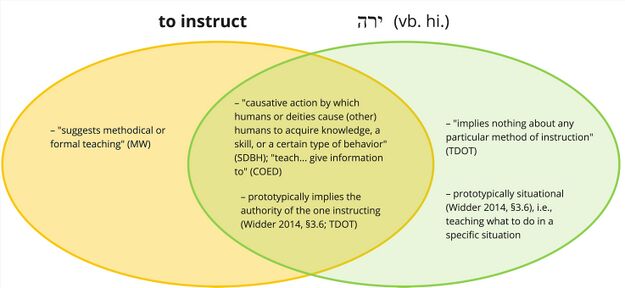
- The verb instruct (ירה hiphil) (vv. 8, 12), by contrast, is more situational: "In its prototypical usage, it refers to an authoritative person providing situational instruction to another."[48] The following diagram explores the similarities and differences between the Hebrew word ירה (hiphil) and the English gloss "instruct."
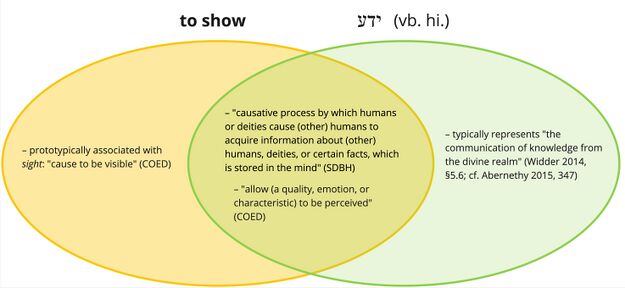
- The verb show (ידע hiphil) (vv. 4, 14) is the most expansive of the three terms, and it represents, prototypically, "the communication of knowledge from the divine realm. A student is caused to know something – that is, s/he is put in a state of knowing."[49] The following diagram explores the similarities and differences between the Hebrew word ידע (hiphil) and the English gloss "show."
- The verb guide (הדרך) (vv. 5, 9) (not analyzed by Widder), according to SDBH, describes a "causative action by which humans or deities give instructions to (other) humans with respect to a certain aspect of life, ◄ as if they take them by the hand and lead them along the way."[50]


v. 5
| Hebrew | Verse | English |
|---|---|---|
| הַדְרִ֘יכֵ֤נִי בַאֲמִתֶּ֨ךָ ׀ | v. 5a | Guide me in your truth; |
| לַמְּדֵ֗נִי כִּֽי־אַ֭תָּה אֱלֹהֵ֣י יִשְׁעִ֑י | v. 5b | teach me; because you are the God who saves me. |
| אוֹתְךָ֥ קִ֝וִּ֗יתִי כָּל־הַיּֽוֹם׃ | v. 5c | I hope in you all day |
Expanded Paraphrase The words in <i>italics</i> provide a fuller sense of the psalm; the text itself is in <b>bold</b>.
Notes
In the he verse, the psalmist continues to ask YHWH for instruction and guidance. He can only be rescued from his enemies if YHWH, the God who saves him (v. 5b), first teaches him to walk in covenant faithfulness. The only way out of the psalmist's distress is to walk in YHWH's paths.
- For the word guide (הַדְרִיכֵנִי), see the note on v. 4 about teaching-related words.
- The phrase your truth (בַאֲמִתֶּךָ) is another way of referring to the covenant instruction in which YHWH teaches his people to walk (cf. "your ways" and "your paths" in v. 4). YHWH's teaching "is truth (אֱמֶת)" (Ps 119:142), and the psalmist wants to live his life according to that teaching.
- For the word teach (לַמְּדֵנִי), see the note on v. 4 about teaching-related words.
- There is a minor textual issue in v. 5b, which also affects the line division of the verse. In short, we prefer to group the phrase "teach me" (לַמְּדֵנִי) with v. 5b (so LXX) instead of with v. 5a (so MT). We also prefer to omit the waw conjunction before "teach me" (so 11Q7).[51]
- In v. 5c, some scholars propose adding a waw conjunction to the beginning of the line (וְאוֹתְךָ) so that the missing waw letter of the acrostic is restored.[52] This proposal raises two distinct issues: (1) whether וְאוֹתְךָ is the earlier reading, and (2) even if ואותך is the earlier reading, whether v. 5c would then constitute the missing waw verse. In our view, neither of these claims is likely.[53] The best explanation is that the original psalm had no waw verse at all, just like Psalm 34. Both Psalm 25 and Psalm 34 lack a waw verse and add a pe verse at the end of the psalm.[54]
- The object you (אוֹתְךָ) is fronted for marked focus: "it's in you that I hope" (cf. vv. 1–2).
v. 6
| Hebrew | Verse | English |
|---|---|---|
| זְכֹר־רַחֲמֶ֣יךָ יְ֭הוָה | v. 6a | Remember your compassion, YHWH, |
| וַחֲסָדֶ֑יךָ כִּ֖י מֵעוֹלָ֣ם הֵֽמָּה׃ | v. 6b | and [remember] your acts of loyalty, because they have been around forever. |
Expanded Paraphrase The words in <i>italics</i> provide a fuller sense of the psalm; the text itself is in <b>bold</b>.
Notes
It is not enough, however, to start walking in covenant faithfulness. The psalmist's past sins, which have caused his present distress, must be dealt with. So, in the zayin verse, the psalmist begins to request forgiveness based on YHWHs' ancient, unchanging character.
- In v. 6, the psalmist turns from asking for guidance (vv. 4–5) to asking for forgiveness (vv. 6–7). "Why should he ask the forgiveness of his sins, by having recourse to the mercy of God, but because he acknowledged that by the cruel treatment he received from his enemies, he only suffered the punishment which he justly merited? He has, therefore, acted wisely in turning his thoughts to the first cause of his misery, that he may find out the true remedy; and thus he teaches us by his example, that when any outward affliction presses upon us, we must entreat God not only to deliver us from it, but also to blot out our sins, by which we have provoked his displeasure, and subjected ourselves to his chastening rod."[55]
- The verb remember (זְכֹר) introduces the zayin verse of the acrostic. It is a keyword in this section of the psalm (vv. 6–7), occurring three times in these two verses. It describes an "action by which humans or deities reprocess information that is stored in their mind" (SDBH; cf. NRSVue: "be mindful").
- The psalmist asks YHWH to remember two things: (1) his compassion (רַחֲמֶיךָ), and (2) his acts of loyalty (חֲסָדֶיךָ). The first word describes a "state in which humans feel compassion for others, ◄ caused by affection for that person and/or the lack of well-being of that person; ► this feeling is usually translated into action" (SDBH). The second word (חֲסָדֶיךָ) does not describe an abstract quality (e.g., "loyalty" or "love," so NIV, NLT, ESV, CSB), but concrete actions: "faithful deeds" (NET). When the noun חֶסֶד is singular, it describes a "state in which humans or deities are committed towards fulfilling their obligations and show that by their actions" (SDBH). But when it is plural, as it is here, it is probably "used to denote a number of specific acts of חֶסֶד."[56]
- According to the Masoretic accents the phrase "your acts of loyalty" (וַחֲסָדֶ֑יךָ) is grouped with the a-line. According to this division, v. 6a would be a single clause with a compound object: "Remember, LORD, your great mercy and love" (NIV). But the Septuagint groups "your acts of loyalty" (or, in the Septuagint, "your mercies") with the b-line: "Be mindful of your acts of compassion, O Lord // and your mercies, because they are from of old."[57] According to this division, it is probably best to read "your acts of loyalty" (וַחֲסָדֶיךָ) as the start of a new clause with an elided verb: "Remember your acts of compassion YHWH // and [remember] your acts of loyalty, because they have been around forever." This division of the text makes for slightly better balance and stronger correspondence between the lines. It also best explains the position of the vocative "YHWH," which helps to demarcate the end of the poetic line.[58]
- The because (כִּי) clause in v. 6b grounds the request of the previous two clauses. "The reason why I am appealing to your compassion and acts of loyalty is because they have been around forever."
- The phrase been around forever (מֵעוֹלָם) literally means "from of old, everlasting, since ancient time, for a long time."[59] Psalm 90:2, for example, says, "Before the mountains were brought forth, or ever you had formed the earth and the world, from everlasting (וּֽמֵעֹולָם) to everlasting you are God" (ESV). In Psalm 25:6, modern English translations use phrases such as "from of old" (NIV, ESV), "have existed from antiquity" (CSB), and "are as old as time" (NJPS). The translation "have been around forever" captures the sense of antiquity (עוֹלָם "foreverness") as well as the sense of continuing existence/relevance using a natural English expression.
- The predicate complement "they have been around forever" (מֵעוֹלָם) is fronted for marked focus. Because they have been around forever (and not for a little while), they are a reliable basis for his appeal. Notice also the contrast between the antiquity of YHWH's compassion (v. 6) and the psalmist's youthful sins described in the next verse (v. 7).
v. 7
| Hebrew | Verse | English |
|---|---|---|
| חַטֹּ֤אות נְעוּרַ֨י ׀ וּפְשָׁעַ֗י אַל־תִּ֫זְכֹּ֥ר | v. 7a | Do not remember my youthful sins or my rebellious acts! |
| כְּחַסְדְּךָ֥ זְכָר־לִי־אַ֑תָּה | v. 7b | Remember me according to your loyalty, |
| לְמַ֖עַן טוּבְךָ֣ יְהוָֽה׃ | v. 7c | because of your goodness, YHWH! |
Expanded Paraphrase The words in <i>italics</i> provide a fuller sense of the psalm; the text itself is in <b>bold</b>.
Notes
In the het verse, the psalmist continues to seek YHWH's forgiveness for past sins. His only hope for forgiveness is YHWH's character, his loyalty and goodness. This verse concludes the psalm's opening address to YHWH.
- The compound object in v. 7a, my youthful sins and my acts of rebellion (חַטֹּאות נְעוּרַי וּפְשָׁעַי), is fronted for the sake of the acrostic structure. At the same time, the fronting seems to have the pragmatic effect of marking the topic: "As for my youthful sins and my rebellion..."[60]
- The word youth refers to "the period of a person's life ranging from early childhood to adulthood" (SDBH). The phrase youthful sins (חַטֹּאות נְעוּרַי) points to "the many individual sins committed since the responsible use of reason (Jer 31:19; Job 13:26)."[61] "Considering that he had not begun only of late to commit sin, but that he had for a long time heaped up sin upon sin, he bows himself, if we may so speak, under the accumulated load."[62]
- The phrase remember me (זכר ל) (v. 7b) is "a technical term which bears a specific juridicial meaning: to credit to one's account [cf. Neh 5:19; Pss 132:1; 137:7; Jer 2:2]. The expression... should be distinguished in meaning from the general sense of 'remember'. There is, however, an idiom which continues to carry the same strong forensic flavour without the use of the preposition. It is the expression 'to remember one's sins' [Ps 25:7a], in which case, 'in one's disfavor' is presupposed (cf. Isa 43:25; 64:8; Jer 14:10; Hos 7:2; 8:13; 9:9)."[63]
- The phrase according to your loyalty (כְּחַסְדְּךָ) specifies the quality according to which the psalmist asks YHWH to remember him: "according to" (KJV, NIV, ESV), "in keeping with" (CSB, NJPS), "in light of" (NLT).[64] The phrase is fronted for replacing focus: "not according to my sins, but according to your loyalty."
- The phrase because of your goodness (לְמַעַן טוּבְךָ) designates a causal relationship, that is, YHWH's goodness (v. 7c) serves as the grounds, or basis, of his remembering the psalmist according to loyalty (v. 7b) and not according to his sins.[65]
- The clause-final vocative at the end of v. 7, YHWH, marks the end of the psalm's opening address to YHWH.[66] Whereas vv. 1–7 are addressed to YHWH in the second person, vv. 8–14 (with the exception of v. 11) will talk about YHWH in the third person. The clause-final vocative in v. 7 helps to mark this shift.
(vv. 8–14)
Verse 8–14, which contain the next seven letters of the acrostic (tet–samek) make up the central section of the psalm. Whereas the previous section (vv. 1–7) was an address to YHWH in the second person, this section talks about YHWH in the third person, except for the central verse of this section (v. 11), which addresses YHWH directly. This central section has an ABCXABC structure that marks v. 11 as the central verse, not only of this section, but of the entire psalm.[67]
- The A parts of the section (vv. 8, 12) use the distinct combination of words, "instruct in the way" (יוֹרֶה בְּדֶרֶךְ).
- The B parts of the section (vv. 9, 13) are characterized by yiqtol verbs, promonimal suffixes that point back to the preceding verse ("his way" // "he himself... his offspring"), and a unique rhythm of 3/3 prosodic words.
- The C parts of the section (vv. 10, 14) each begin with a construct phrase featuring YHWH ("YHWH's paths" // "YHWH's personal counsel") and mention "his covenant" (בְרִיתוֹ) in the b-line.
- The central X part of the section (v. 11) is the only verse in this section that addresses YHWH directly.
The concentric structure of vv. 8–14 and the centrality of v. 11 (not only for vv. 8–14, but for the whole psalm) becomes evident at various layers of analysis. For example, speech act analysis reveals the following pattern:
Participant analysis reveals a similar pattern, in which vv. 8–14 constitute the central section, with v. 11 at the center.
(Click diagram to enlarge)

Verse 11, which has the psalmist in first person and YHWH in second person, is surrounded on either side with a cluster of three verses describing those who hope in YHWH.
v. 8
| Hebrew | Verse | English |
|---|---|---|
| טוֹב־וְיָשָׁ֥ר יְהוָ֑ה | v. 8a | YHWH is good and just; |
| עַל־כֵּ֤ן יוֹרֶ֖ה חַטָּאִ֣ים בַּדָּֽרֶךְ׃ | v. 8b | therefore, he instructs sinners in the way. |
Expanded Paraphrase The words in <i>italics</i> provide a fuller sense of the psalm; the text itself is in <b>bold</b>.
Notes
In the previous verses (vv. 6–7), the psalmist based his request on YHWH's character. Now, in the tet verse, he turns to reflect on YHWH's character: his goodness and justice, as well as what these attributes mean for how he deals with sinners.
- The predicate complement in v. 8, good and just (טוֹב־וְיָשָׁר) is fronted for acrostic structure (tet verse). At the same time, it also seems to have a pragmatic effect (marked focus). The subject, "YHWH," is already discourse active, and the adjectives "good and just" predicate something about him. What is YHWH like? He is good and just (v. 8a). And it's because of these attributes (therefore) that he instructs sinners in the way (v. 8b).
- Instructing sinners in the way he "show sinners the way of repentance;"[68] "he stretches forth his hand to sinners to bring them back again into the way."[69] Similarly, in Psalm 51, the psalmist vows to "teach transgressors your ways, so that sinners will turn back to you" (Psalm 51:15, CBC).
- On the verb instructs (יוֹרֶה) see the note on v. 4 about teaching-related verbs.
- The phrase in the way (בַּדָּרֶךְ) introduces "the way" as the content of the instruction ("instruct in the way" = "teach about the way"). The hiphil verb "instruct" is causative, meaning, "cause someone to pay attention to something," and the bet preposition signifies the thing to which the person is made to pay attention.[70]
- The phrase "in the way" is vocalized with the definite article (בַּדָּרֶךְ), implying that the "way" is identifiable in the context. It refers to the same "way(s)" mentioned in vv. 4–5, the way of covenant instruction, the "truth" (v. 5a), by which YHWH himself walks and in which he teaches his people to walk.
v. 9
| Hebrew | Verse | English |
|---|---|---|
| יַדְרֵ֣ךְ עֲ֭נָוִים בַּמִּשְׁפָּ֑ט | v. 9a | He guides afflicted people in justice |
| וִֽילַמֵּ֖ד עֲנָוִ֣ים דַּרְכּֽוֹ׃ | v. 9b | and teaches afflicted people his way. |
Expanded Paraphrase The words in <i>italics</i> provide a fuller sense of the psalm; the text itself is in <b>bold</b>.
Notes
In the yod verse, the psalmist continues to reflect on how YHWH deals with suffering sinners in light of his character, how he graciously teaches them to walk in covenant faithfulness.
- On the meaning of the verbs guide and teach, see the note on v. 4 about teaching-related words in this psalm.
- Most modern translations render the yiqtol verbs in v. 9 as indicatives: he guides... he teaches (cf. NRSVue, NJPS, NIV, NLT, ESV, CEB, CSB, GNT, LUT, HFA, NGÜ, ELB, EÜ, GNB, ZÜR). However, the verb form for "he guides" (יַדְרֵךְ) is a short yiqtol form, which usually has jussive semantics.[71] For this reason, the NET Bible gives the following translation: "May he show the humble what is right. May he teach the humble his way." But the indicative translation makes the most sense in the context. Verse 8a describes YHWH's character – "good and just" – and vv. 8b–9 then describe YHWH's characteristic activity, which flows out of his character: "Therefore, he instructs sinners... he guides the afflicted... he teaches the afflicted." For this reason, it is generally acknowledged that, despite the short form, these clauses in v. 9 are indicative.[72] Commenting on this and similar forms, Waltke and O'Connor give helpful advice: "These unexpected jussive forms may be due to the confusion between the form groups or to textual corruptions; or they may represent vestiges of an earlier verbal system. Some grammarians explain them on rhythmical grounds. Because of this minor formal confounding, it is best in problem passages of this nature to be governed by sense rather than by form."
v. 10
| Hebrew | Verse | English |
|---|---|---|
| כָּל־אָרְח֣וֹת יְ֭הוָה חֶ֣סֶד וֶאֱמֶ֑ת | v. 10a | All of YHWH's paths are loyalty and faithfulness |
| לְנֹצְרֵ֥י בְ֝רִית֗וֹ וְעֵדֹתָֽיו׃ | v. 10b | for those who keep his covenant and his demands. |
Expanded Paraphrase The words in <i>italics</i> provide a fuller sense of the psalm; the text itself is in <b>bold</b>.
Notes
The kaf verse continues to reflect on YHWH's character, summarized as "loyalty and faithfulness." The blessings of YHWH's loyalty and faithfulness, however, are only experienced by those who keep his covenant. Thankfully, YHWH himself makes this happen, transforming his people from "sinners" (v. 8) to faithful covenant partners (v. 10).
- The phrase all of YHWH's paths (כָּל־אָרְחוֹת יְהוָה), which begins the kaf verse of the acrostic, refers to YHWH's dealings with his people, his characteristic activity towards his covenant partners. When his people keep his covenant (v. 10b), they experience the blessings of his loyalty and faithfulness. For a similar idea, see Exodus 20:5–6: "showing love to a thousand generations of those who love me and keep my commandments" (Exod 20:5–6, NIV).
- The descriptions in vv. 8–10 seem to represent a progression: "sinners" (v. 8) → "afflicted" (v. 9) → those who keep his covenant and his demands" (v. 10). In other words, YHWH's people begin as "sinners" (v. 8), and their sin leads to their being "afflicted" (v. 9). But YHWH guides them (vv. 8–9) so that they become people who "keep his covenant and his demands" (v. 10).
- The two parts of the phrase his covenant and his demands (בְרִיתוֹ וְעֵדֹתָיו) refer to two aspects of the same thing: "his covenant demands."[73] The word covenant (בְּרִית) refers to "an enduring agreement which defines a relationship between two parties involving a solemn, binding obligation(s) specified on the part of at least one of the parties toward the other, made by oath under threat of divine curse, and ratified by a visual ritual."[74] The word demands (וְעֵדֹתָיו) refer to the binding obligations of the agreement, the "stipulation[s] accompanying, and as such bearing testimony to, a legal agreement such as a covenant" (SDBH).
v. 11
| Hebrew | Verse | English |
|---|---|---|
| לְמַֽעַן־שִׁמְךָ֥ יְהוָ֑ה | v. 11a | Because of your name, YHWH, |
| וְֽסָלַחְתָּ֥ לַ֝עֲוֺנִ֗י כִּ֣י רַב־הֽוּא׃ | v. 11b | forgive my guilt, because it is great! |
Expanded Paraphrase The words in <i>italics</i> provide a fuller sense of the psalm; the text itself is in <b>bold</b>.
Notes
The lamed verse is the central verse of the psalm. Here, the psalmist asks for the forgiveness of his sins on the sole basis of YHWH's character.
- The phrase because of your name (לְמַעַן־שִׁמְךָ) designates a causal relationship; that is, YHWH's name, or identity (v. 11a), serves as the grounds, or basis, of his forgiveness (v. 11b).[75] A person's "name" represents "the core of one's identity, which reflects the essence of one's being" (SDBH), and the essence of YHWH's being is mercy, compassion, patience, loyalty, and faithfulness (Exod 33:19; 34:6–7). Hence, we might paraphrase: "Because of who you are, YHWH (a God who is merciful and compassionate...), forgive my guilt."
- The fronting of the phrase "because of your name" at the beginning of v. 11 has a double function. First, it fulfills the requirements of the acrostic structure (the lamed verse). Second, it brings the content of the phrase into marked focus: "if because of nothing else than your name YHWH, would you forgive my guilt." In other words, David's only appeal is to YHWH's name, i.e., his character. As Theodoret writes, "I beg you... to have mercy on my sins, he is saying, not on account of my prompt repentance, but for the name you have for loving-kindness and because I rested my hope in your name."[76] The vocative in v. 11a, YHWH, further helps to focus the phrase.[77]
- The choice of verb form in v. 11b is somewhat unexpected. Forgive (וְסָלַחְתָּ) is a weqatal verb rather than an imperative or a yiqtol.[78] The waw in וְסָלַחְתָּ is the so-called "waw of apodosis," introducing the main clause following an adverbial.[79] It seems likely that this verb form (weqatal) was chosen to allude to Exodus 34:9: "Although this is a stiff-necked people, forgive our guilt (וְסָלַחְתָּ לַעֲוֺנֵנוּ) and our sin."[80] At the same time, the waw of apodosis might have pragmatic significance, marking the boundary between the main clause (סָלַחְתָּ) and the adverbial constituent (למען שׁמך יהוה), which has a function of "Orientation."[81]
- For verbs of forgiveness (e.g., סלח in v. 11 and נשׂא in v. 18), the patient, i.e., the person or sin which is forgiven, is often indicated with a lamed preposition (v. 11: וְסָלַחְתָּ לַעֲוֺנִי; v. 18: וְשָׂא לְכָל־חַטֹּאותָי).[82] This is always the case for the verb סלח in the Bible.
- The because (כִּי) clause in v. 11b explains why it is that he needs forgiveness and why he can appeal to nothing less than YHWH's name. It is because his sin is great (רַב). The word "great" is fronted for marked focus: "not small, but great."
- The subject of the clause in v. 11b (רַב־הוּא) is somewhat ambiguous. It could mean either, "because it (= my guilt) is great" or "because it (= your name) is great." The ambiguity might be deliberate, such that the clause has a double meaning.[83] Nevertheless, the more likely subject – the one that would probably first come to mind in a surface reading of the text – is "my guilt." Not only is "my guilt" the immediately preceding noun phrase, but, as Baethgen notes, the adjective רַב works better with "guilt" than with "name." If the poet meant to talk about YHWH's "name" being "great," he could have used the more appropriate adjective גָּדוֹל.[84]
v. 12
| Hebrew | Verse | English |
|---|---|---|
| מִי־זֶ֣ה הָ֭אִישׁ יְרֵ֣א יְהוָ֑ה | v. 12a | Who is the person who fears YHWH? |
| י֝וֹרֶ֗נּוּ בְּדֶ֣רֶךְ יִבְחָֽר׃ | v. 12b | He will instruct him in the way he should choose. |
Expanded Paraphrase The words in <i>italics</i> provide a fuller sense of the psalm; the text itself is in <b>bold</b>.
Notes
The mem verse returns to describing YHWH's dealings with people, now focusing on how he relates to those who fear him. The person who fears YHWH will benefit from YHWH's guidance in all of life's situations.
- The question Who is the person who fears YHWH? has a double rhetorical function. First, it announces the topic of the following mini-discourse (vv. 12–14), i.e., the person who fears YHWH. Second, it gets the listener's attention (cf. Ps 34:13). "Who is the person who fears YHWH?" = "Listen up, you who fear YHWH!"
- On the verb instruct, see the note on v. 4.
- On the way imagery, see the note on v. 4.
- The final clause of v. 12 (יִבְחָר) is a relative clause: "the way that he should choose" (ESV).[85]
- Given the context, the yiqtol verb at the end of v. 12 (יִבְחָר) is modal: "the way he should choose" (NRSVue, ESV, NIV, NLT, CSB; cf. NET, LUT, HFA, NGÜ, ELB, EÜ, GNB, ZÜR). The specific type of modality might be labeled obligation or necessity.[86]
v. 13
| Hebrew | Verse | English |
|---|---|---|
| נַ֭פְשׁוֹ בְּט֣וֹב תָּלִ֑ין | v. 13a | He himself will stay in a good place, |
| וְ֝זַרְע֗וֹ יִ֣ירַשׁ אָֽרֶץ׃ | v. 13b | and his offspring will possess land. |
Expanded Paraphrase The words in <i>italics</i> provide a fuller sense of the psalm; the text itself is in <b>bold</b>.
Notes
The nun verse describes the multi-generational blessings for those who fear YHWH and receive his guidance. Not only will they themselves live good lives, but their offspring will also experience the blessings of YHWH's covenant faithfulness.
- The subject he himself (נַפְשׁוֹ) is, more literally, "his life" or "his soul" (KJV, ESV). It is the same word translated "soul" in v. 1. In this context, however, where it is contrasted with "his offspring" (וְזַרְעוֹ, v. 13b), it appears to refer to the person himself as distinct from his offspring: "he himself will live a good life, and then, after he dies, his offspring after him will inherit his property and continue to possess the land that YHWH promised to Abraham. The verse describes the generational blessings for covenant obedience (cf. Exod 20:6). The word order seems to support this interpretation; the subjects in v. 13 are fronted for marked topic: "As for he himself... and as for his offspring..."[87]
- The verb stay (לין) often has the concrete meaning "spend the night" (SDBH). In this context, however, it describes more generally a "state in which humans... stay in a certain place for an indefinite amount of time" (SDBH). The CSB says, "He will live a good life," and the GNT says, "they will always be prosperous" (see also RJPS). Other interpreters have seen a reference to death and the afterlife in this verse: "his soul will stay in a good place in his death."[88]
- Because the verb "stay" describes a "state in which humans... stay in a certain place for an indefinite amount of time" (SDBH), the adverbial בְּטוֹב has a spatial sense: in a good place, metaphorically extended to mean "in a good state."[89] Like the Hebrew phrase בְּטוֹב, the English phrase "in a good place" can refer to an abstract state as well as to a physical location.
- The verb possess (יִירַשׁ) is often translated as "inherit" (e.g., NIV, NLT, ESV, RJPS, CSB), though some translations have "possess" (e.g., NRSVue, GNT).[90] Despite the popularity of the gloss "inherit" for the verb ירשׁ, this meaning is relatively rare in the Bible and appears to be late. As Lohfink writes, "Only in very late passages does this usage come to refer also to inheritance of the family’s wealth by whoever takes over family leadership when the father dies. Earlier contexts always involve 'acquisition' of something additional, without stipulating the specific mode of acquisition, usually purchase."[91] This developed meaning of the verb ("inherit") might reflect Aramaic influence (cf. Aramaic ירת).
- The land (אֶרֶץ) refers to the land of Canaan, which YHWH promised to give to Abraham and his descendants (Gen 12:7; 15:7, 18-21). In the conquest of Canaan under Joshua, YHWH fulfilled his promise (Josh 21:43-45; Jdg 2:6; 1 Kgs 8:56), but Israel's continued possession of the land depended on their faithfulness to the covenant (Lev 26; Deut 28; cf. Ezra 9:12; 1 Chron 28:8).
v. 14
| Hebrew | Verse | English |
|---|---|---|
| ס֣וֹד יְ֭הוָה לִירֵאָ֑יו | v. 14a | YHWH's personal counsel and his covenant are for those who fear him, |
| וּ֝בְרִית֗וֹ לְהוֹדִיעָֽם׃ | v. 14b | and his covenant are for those who fear him, for teaching them. |
Expanded Paraphrase The words in <i>italics</i> provide a fuller sense of the psalm; the text itself is in <b>bold</b>.
Notes
The samek verse continues to describe how YHWH relates to those who fear him, teaching them how to live.
- We have interpreted v. 14 as a case of vertical grammar: "YHWH's counsel and his covenant [instruction] are [given] to those who fear him in order to teach them" (cf. grammar note on v. 1).[92]
- The noun סוֹד, in its most basic sense, can describe "a group or gathering of persons (like friends or members of the same group)" (SDBH).[93] The word has several other senses, which are figurative extensions of this basic sense (see SDBH): "friendship" (the kind of relationship that binds members of the סוֹד) (cf. Ps 55:15), "secret" (the kind of information discussed privately in a סוֹד) (cf. Prov 11:13), and "plot" (a decision or plan formulated in a סוֹד) (cf. Ps 64:3). Modern translations differ as to which sense of the word is activated in Psalm 25:14: "friendship" (ESV, cf. CEV, GNT; SDBH) or "secret counsel" (CSB, cf. KJV, NET, NJPS, LUT, EÜ, ZÜR; HALOT). Given the emphasis on YHWH "teaching" throughout the psalm, the second of these senses ("secret counsel") is the most likely. This interpretation is especially likely if the phrase "for teaching them" modifies the whole verse (see Grammar notes). Cf. NET: "The LORD's loyal followers receive his guidance."[94]
- Some Septuagint manuscripts have an extra line for v. 14, which sits in between the two lines of the Masoretic Text: καὶ τὸ ὄνομα κυρίου τῶν φοβουμένων αὐτόν. See Rahlfs 1931, 115. The extra line is also present in Ra 2110 (unknown to Rahlfs). The presence of this line in these manuscripts raises questions, e.g., (1) Is the line original to the Old Greek translation? (2) If so, does it represent a Hebrew line that is now missing? Neither question is easy to answer. Regarding the first question, Dorival (2021, 372–373) thinks that the line is probably part of the Old Greek text. Yet he also notes that the line ends in the same way as the previous line, v. 14a (τῶν φοβουμένων αὐτόν), and so he suggests that this extra line might be a doublet, a second translation of v. 14a.[95] Whatever the case may be, the issue is shrouded in enough uncertainty that it seems prudent not to emend the Hebrew text based on this additional line.
- This second alternative diagram reflects two different interpretations, one of v. 14a and one of v. 14b. The interpretation of v. 14a is reflected in the Septuagint: "The Lord is empowerment (κραταίωμα) for those who fear him" (NETS). It analyzes v. 14a as a verbless clause with סוֹד as the predicate, and it depends on a distinct understanding of the meaning of סוֹד (κραταίωμα, from יסד?).
- The interpretation of v. 14b is preferred by Baethgen (1904, 72): "And to teach them his covenant [he endeavors]." According to this interpretation, "covenant" is the object of the infinitive "to teach,"[96] and a verb is implied, e.g., "he endeavors."
(vv. 16, 15–22)
The final section of the psalm has a chiastic structure.[97]
- The outer sections of the chiasm (vv. 16, 22) begin with the letter pe and have similar sounds: pene el... // pede el.
- The innermost section of the chiasm (vv. 18–19) has two verses that begin with the same word, "Look!" The b-lines of these verses also begin with similar sounds: waw + sin.
- The remaining sections of the chiasm (vv. 15, 17 and vv. 20–21) are characterized by the language of hope ("eyes on YHWH..." // "refuge in you... hope in you") and rescue ("bring out... bring out... // "guard... rescue... keep safe...").
In order to achieve this chiastic structure, the poet has deliberately departed from the constraints of the acrostic. Instead of the expected order (v. 18: qof; v. 19: resh), the poet has replaced the first qof with a resh. This unexpected move draws attention to v. 18, the point of variation, which also becomes the center of the chiastic arrangement. The prominent position of v. 18 is significant for grasping the poem's message. This verse is a request for the forgiveness of sins: "forgive all my sins!" Note that the central verse in the psalm (v. 11) is also a request for the forgiveness of sins (see above). The poet has gone out of his way to highlight the theme of forgiveness.
v. 16
| Hebrew | Verse | English |
|---|---|---|
| פְּנֵה־אֵלַ֥י וְחָנֵּ֑נִי | v. 16a* | Turn towards me and be merciful to me, |
| כִּֽי־יָחִ֖יד וְעָנִ֣י אָֽנִי׃ | v. 16b* | because I am alone and afflicted. |
Expanded Paraphrase The words in <i>italics</i> provide a fuller sense of the psalm; the text itself is in <b>bold</b>.
Notes
In the pe verse, the psalmist returns to requesting YHWH's help. He is alone and afflicted, with no one else to help him. So, he asks YHWH for mercy.
- In the earliest form of Psalm 25, the pe verse (v. 16) probably preceded the ayin verse (v. 15). See The Missing Qof in Psalm 25:18 for a detailed discussion. In short, although most biblical acrostics have the ayin-pe order, which became standard sometime after the exile, several biblical acrostics have the order pe-ayin (e.g., MT Lamentations 2, 3, 4; LXX Prov 31). Scribes sometimes updated the order of these verses to reflect their preferred sequence.[98] There is good evidence to suggest that this kind of updating was applied to certain psalms as well, especially Psalm 34 and Psalm 37.[99] It is likely that these two psalms originally had a pe-ayin order, which was updated to ayin-pe (and the update is reflected in all of our witnesses). Given the structural similarities between Psalm 34 and Psalm 25 – both lack a waw verse and add a pe verse; both are also written by David – it would not be surprising if Psalm 25 also originally had a pe-ayin order.[100] Indeed, a pe-ayin order results in stronger poetic cohesion (note connections between v. 15 and v. 17) and a chiasm that unites the entire third section of the poem (vv. 16, 15–22, see above).
- The predicate complement in v. 16, alone and afflicted, is fronted for marked focus. The subject ("I") is discourse active, and the clause says something new about the subject: "I am alone and afflicted (and that's why I need you to turn towards me and have mercy)."
- The word alone (יָחִיד) (so NLT), in conjunction with the word "afflicted" (עָנִי), describes the psalmist as one who is "deserted" (HALOT; cf. Ps 68:7). "I am alone" in this context means, "I am bereft of all help."[101]
v. 15
| Hebrew | Verse | English |
|---|---|---|
| עֵינַ֣י תָּ֭מִיד אֶל־יְהוָ֑ה | v. 15a* | My eyes are always on YHWH, |
| כִּ֤י הֽוּא־יוֹצִ֖יא מֵרֶ֣שֶׁת רַגְלָֽי׃ | v. 15b* | because he will bring my feet out of a net. |
Expanded Paraphrase The words in <i>italics</i> provide a fuller sense of the psalm; the text itself is in <b>bold</b>.
Notes
In the ayin verse, the psalmist again expresses his hope in YHWH. YHWH alone can rescue him from his enemies, and so he looks to YHWH alone in constant expectation.
- The phrase my eyes are always on YHWH is an expression of hope and confidence in YHWH's ability and willingness to rescue. Compare Psalm 123:2: "As the eyes of servants look to (אֶל) the hand of their master, as the eyes of a female servant look to (אֶל) the hand of her mistress, so my eyes will look to the LORD (עֵינֵינוּ אֶל־יְהוָה), our God, until he shows us favor" (NET).
- The prepositional phrase on YHWH (אֶל־יְהוָה) is, literally, "towards YHWH" (cf. RJPS, ESV). Technically, the אֶל preposition indicates "the goal of an act of observation."[102] The English idiom "my eyes are on someone" nicely captures the sense of the phrase (so also NIV, NLT), even if the English preposition "on" (by itself) does not convey the basic sense of the Hebrew preposition אֶל.
- The clause in v. 15b has an overt subject pronoun, he (הוּא), which is also fronted before the verb. This appears to be a case of marked focus; the psalmist is explaining why his eyes are always on YHWH. It is because YHWH is the one who will rescue him from his distress. See, for example, the NIV: "for only he will release my feet from the snare."
- Nets are "used for hunting birds and other animals, and also for fishing; ≈ associated with aggression and control."[103] To say that his foot is caught in the enemy's net is to say that he is in imminent danger. But he looks to YHWH alone for help, because YHWH alone will bring his foot out of the net.
v. 17
| Hebrew | Verse | English |
|---|---|---|
| צָר֣וֹת לְבָבִ֣י הִרְחִ֑יבוּ | v. 17a | The troubles of my heart have expanded. |
| מִ֝מְּצֽוּקוֹתַ֗י הוֹצִיאֵֽנִי׃ | v. 17b | Bring me out of my distresses! |
Expanded Paraphrase The words in <i>italics</i> provide a fuller sense of the psalm; the text itself is in <b>bold</b>.
Notes
In the tsade verse, the psalmist describes his distressing situation, and he asks YHWH to rescue him from it.
- The interpretation of v. 17 is debated, as the following translations illustrate: (1) "The troubles of my heart are enlarged" (ESV); (2) "Troubles have filled my heart" (cf. NBS); (3) "Relieve the troubles of my heart, and..." (NRSV); (4) "Troubles overwhelm my heart" (cf. ZÜR). See The Text and Meaning of Psalm 25:17a for a detailed discussion. In short, we prefer to follow the Masoretic Text and to interpret the hiphil verb הִרְחִיבוּ as either stative ("be wide") or inchoative ("become wide, expand"): the troubles of my heart have expanded.[104]
- The word for troubles (צָרוֹת) is related to the sense of "narrowness" (SDBH: "as if one were confined to a narrow and cramped space from which there is no escape"). The image of "narrowness" becoming "wide" is a creative, poetic representation of distress increasing.
- The subject in v. 17a (צָרוֹת לְבָבִי) is fronted for the acrostic structure (the tsade verse). At the same time, the clause could be interpreted as thetic, i.e., the entire utterance is new information. Specifically, it could be an explanative thetic, since it provides the grounds for the following imperative.
- The fronting of the prepositional phrase in v. 17b, from my distresses (מִמְּצֽוּקוֹתַי), creates a pattern of repetition:
A. the troubles of my heart
 B. have expanded (verb)
A. from my distresses
 B. bring me out (verb)
- The word distresses (מְצוּקוֹתַי) in the b-line seems to refer generally to the suffering that he is experiencing (internal and external) due to his difficult situation.
v. 18
| Hebrew | Verse | English |
|---|---|---|
| רְאֵ֣ה עָ֭נְיִי וַעֲמָלִ֑י | v. 18a | Look at my affliction and my hardship, |
| וְ֝שָׂ֗א לְכָל־חַטֹּאותָֽי׃ | v. 18b | and forgive all my sins! |
Expanded Paraphrase The words in <i>italics</i> provide a fuller sense of the psalm; the text itself is in <b>bold</b>.
Notes
Instead of the expected qof, verse 18 begins with resh. In this highly-marked verse, the psalmist asks YHWH to take notice of his affliction and hardship and to forgive his sins, which are the root cause of his distress.
- On the prominence of v. 18, see the discussion in the introduction to this page. See also the exegetical issue, The Missing Qof in Psalm 25:18.
v. 19
| Hebrew | Verse | English |
|---|---|---|
| רְאֵֽה־אוֹיְבַ֥י כִּי־רָ֑בּוּ | v. 19a | Look at my enemies, how they have multiplied |
| וְשִׂנְאַ֖ת חָמָ֣ס שְׂנֵאֽוּנִי׃ | v. 19b | and how they hate me with violent hatred! |
Expanded Paraphrase The words in <i>italics</i> provide a fuller sense of the psalm; the text itself is in <b>bold</b>.
Notes
In this second resh verse, the psalmist asks YHWH to notice the urgent threat posed by his enemies. There are many of them, and they are dangerous.
- The NET translates the כּי in v. 19a as a subordinating causal conjunction: "Watch my enemies, for they outnumber me" (NET). It is more likely, however, that the כּי introduces the content of what is "seen" (ראה): "See how numerous are my enemies and how fiercely they hate me!" (NIV).[105]
- SDBH defines the verb translated have multiplied (רָבּוּ), not as a state ("be many" – so most English translations),[106] but as a "process by which people... increase in number or frequency" (italics added).[107]
- The adverbial violent hatred (וְשִׂנְאַת חָמָס) is fronted, probably for marked (scalar) focus: "how they hate me with such violent hatred!" The psalmist wants YHWH to see, not just that his enemies hate him, but that their hatred is intense and ready to spill over into violence.
v. 20
| Hebrew | Verse | English |
|---|---|---|
| שָׁמְרָ֣ה נַ֭פְשִׁי וְהַצִּילֵ֑נִי | v. 20a | Guard my life and rescue me! |
| אַל־אֵ֝ב֗וֹשׁ כִּֽי־חָסִ֥יתִי בָֽךְ׃ | v. 20b | Do not let me be disappointed, because I have taken refuge in you! |
Expanded Paraphrase The words in <i>italics</i> provide a fuller sense of the psalm; the text itself is in <b>bold</b>.
Notes
In the shin verse, the psalmist asks for protection from his enemies. He also expresses his dependence on YHWH. He has put all of his hope in YHWH, and if YHWH does not come through, it will mean utter disappointment and defeat.
- For the word be disappointed, see the note on v. 2.
v. 21
| Hebrew | Verse | English |
|---|---|---|
| תֹּם־וָיֹ֥שֶׁר יִצְּר֑וּנִי | v. 21a | May integrity and justice keep me safe, |
| כִּ֝֗י קִוִּיתִֽיךָ׃ | v. 21b | because I hope in you. |
Expanded Paraphrase The words in <i>italics</i> provide a fuller sense of the psalm; the text itself is in <b>bold</b>.
Notes
The tav verse explicitly addresses the relationship between covenant faithfulness and protection from enemies. This relationship, which is vital to understanding the psalm's logic, has been implicit up to this point. The psalmist will only experience YHWH's protection if he embraces a life of covenant faithfulness (= integrity and justice). So, in this verse, he once again asks YHWH to guide him and, in this way, to keep him safe.
- The subject integrity and justice (תֹּם־וָיֹשֶׁר) is fronted for the acrostic structure (tav verse). The fronting could also have the pragmatic effect of introducing "integrity and justice" as the marked topic of the clause: "as for integrity and justice, may they keep me safe."
- Most modern translations render the clause in v. 21 as a directive: May integrity and justice keep me safe (cf. KJV, ESV, NRSVue, NIV, NLT, NET, CSB, RJPS; LUT, ELB, EÜ, GNB, ZÜR).[108] A future translation would also be possible.[109] But a request would fit better in the context (cf. the requests throughout vv. 16–22 and especially the connection between v. 21 and v. 20).
- The Septuagint, according to Rahlfs edition (1931, 116) adds a vocative "Lord" (κύριε = יהוה) to the end of v. 21. Based on this evidence, some scholars emend the Hebrew text, noting that the vocative would make for better balance (8 syllables // 7 syllables) and reinforce the inclusio between v. 1 and vv. 21–22 (יהוה אלהים // יהוה אלהי).[110] It would also significantly enhance the chiastic connection that already exists between v. 15 and v. 21 (see Poetic Structure). However, as Barthélemy et al. note, the vocative is absent in important Septuagint witnesses, including Sinaiticus and Ra 2110 (unknown to Rahlfs).[111] It might have arisen as a secondary addition within the Greek tradition.[112] On the other hand, it is also plausible that the Greek text originally included the vocative and that the omission of the vocative in some witnesses represents an assimilation to the Hebrew text.[113]
v. 22
| Hebrew | Verse | English |
|---|---|---|
| פְּדֵ֣ה אֱ֭לֹהִים אֶת־יִשְׂרָאֵ֑ל | v. 22a | God, redeem Israel |
| מִ֝כֹּ֗ל צָֽרוֹתָיו׃ | v. 22b | from all their troubles! |
Expanded Paraphrase The words in <i>italics</i> provide a fuller sense of the psalm; the text itself is in <b>bold</b>.
Notes
The additional pe verse asks that God would redeem Israel from all their troubles. This final verse sets up an analogy between David (vv. 1–21) and Israel (v. 22) and thus turns the entire psalm into a prayer for the redemption of Israel.
- Just as YHWH made a covenant with David, so he had previously made a covenant with Israel. If Israel walked in YHWH's ways, they would experience YHWH's loyalty and faithfulness (Exod 20:6); but if they sinned and rebelled against YHWH, they would be punished (Exod 19–24; Deut 28).[114]
- "Prayer offered to God befits a king: it is appropriate for one appointed to rule to exercise complete care of his subjects. This is surely the reason that blessed David offered prayer not only for himself but also for a people entrusted to him, especially as the one who reigns wisely and well constitutes the welfare of the whole people."[115]
- The vocative in v. 22, God, which is the only vocative since v. 11, is in second position. Perhaps it is drawing attention to the following sentence constituent, Israel.[116] An emphasis on Israel in this line would make sense, since the whole point of the line seems to be to apply David's prayer (vv. 1–21) to Israel.
- As with v. 1, it is not clear whether v. 22 consists of one line or two lines. The Masoretic accents suggest a two-line division, which would be consistent with the rest of the psalm.
Legends
Grammatical diagram
| Visualization | Description |
|---|---|
 |
The clause is represented by a horizontal line with a vertical line crossing through it, separating the subject and the verb. |
 |
The object is indicated by a vertical line that does not cross the horizontal line of the clause. Infinitives and participles may also have objects. If the direct object marker (d.o.m.) is present in the text, it appears in the diagram immediately before the object. If the grammar includes a secondary object, the secondary object will appear after the object, separated by another vertical line that does not cross the horizontal line of the clause. |
 |
The subject complement follows the verb (often omitted in Hebrew) separated with a line leaning toward the right. It can be a noun, a whole prepositional phrase or an adjective. The later two appear modifying the complement slot. |
 |
When a noun further describes or renames the object, it is an object complement. The object complement follows the object separated by a line leaning toward the right. |
 |
In a construct chain, the noun in the absolute form modifies the noun in the construct form. |
 |
Participles are indicated in whatever position in the clause they are in with a curved line before the participle. Participles can occur as nominal, where they take the place of a noun, predicate, where they take the place of a verb, or attributive, where they modify a noun or a verb similar to adjectives or adverbs. |
 |
Infinitives are indicated by two parallel lines before the infinitive that cross the horizontal line. Infinitive constructs can appear as the verb in an embedded clause. Infinitive absolutes typically appear as an adverbial. |
 |
The subject of the infinitive often appears in construct to it. In this situation, the infinitive and subject are diagrammed as a construct chain. |
 |
The object of the infinitive is indicated by a vertical line that does not cross the horizontal line of the infinitival clause. |
 |
Modifiers are represented by a solid diagonal line from the word they modify. They can attach to verbs, adjectives, or nouns. If modifying a verb or adjective, it is an adverb, but if modifying a noun, it is an adjective, a quantifier, or a definite article. If an adverb is modifying a modifier, it is connected to the modifier by a small dashed horizontal line. |
 |
Adverbials are indicated by a dashed diagonal line extending to a horizontal line. These are nouns or infinitives that function adverbially (modifying either a verb or a participle), but are not connected by a preposition. |
 |
Prepositional phrases are indicated by a solid diagonal line extending to a horizontal line. The preposition is to the left of the diagonal line and the dependent of the preposition is on the horizontal line. They can modify verbs (adverbial) or nouns (adjectival). |
 |
Embedded clauses are indicated by a "stand" that looks like an upside-down Y. The stand rests in the grammatical position that the clause fulfills. Extending from the top of the stand is a horizontal line for the clause. If introduced by a complementizer, for example כִּי, the complementizer appears before the stand. Embedded clauses can stand in the place of any noun. |
 |
When clauses are joined by a conjunction, they are compound clauses. These clauses are connected by a vertical dotted line. The conjunction is placed next to the dotted line. |
 |
Within a clause, if two or more parts of speech are compound, these are represented by angled lines reaching to the two compound elements connected by a solid vertical line. If a conjunction is used, the conjunction appears to the left of the vertical line. Almost all parts of speech can be compound. |
 |
Subordinate clauses are indicated by a dashed line coming from the line dividing the subject from the predicate in the independent clause and leading to the horizontal line of the subordinate clause. The subordinating conjunction appears next to the dashed line. |
 |
Relative clauses also have a dashed line, but the line connects the antecedent to the horizontal line of the relative clause. The relative particle appears next to the dashed line. |
 |
Sentence fragments are represented by a horizontal line with no vertical lines. They are most frequently used in superscriptions to psalms. They are visually similar to discourse particles and vocatives, but most often consist of a noun phrase (that does not refer to a person or people group) or a prepositional phrase. |
 |
In the body of the psalm, a horizontal line by itself (with no modifiers or vertical lines) can indicate either a discourse particle or a vocative (if the word is a noun referring to a person or people group). A discourse particle is a conjunction or particle that functions at the discourse level, not at the grammatical level. Vocatives can appear either before or after the clause addressed to them, depending on the word order of the Hebrew. |
 |
Apposition is indicated by an equal sign equating the two noun phrases. This can occur with a noun in any function in a sentence. |
| Hebrew text colors | |
|---|---|
| Default preferred text | The default preferred reading is represented by a black line. The text of the MT is represented in bold black text. |
| Dispreferred reading | The dispreferred reading is an alternative interpretation of the grammar, represented by a pink line. The text of the MT is represented in bold pink text, while emendations and revocalizations retain their corresponding colors (see below). |
| Emended text | Emended text, text in which the consonants differ from the consonants of the Masoretic text, is represented by bold blue text, whether that reading is preferred or dispreferred. |
| Revocalized text | Revocalized text, text in which only the vowels differ from the vowels of the Masoretic text, is represented by bold purple text, whether that reading is preferred or dispreferred. |
| (Supplied elided element) | Any element that is elided in the Hebrew text is represented by bold gray text in parentheses. |
| ( ) | The position of a non-supplied elided element is represented by empty black parentheses. For example, this would be used in the place of the noun when an adjective functions substantivally or in the place of the antecedent when a relative clause has an implied antecedent. |
| Gloss text colors | |
|---|---|
| Gloss used in the CBC | The gloss used in the Close-but-Clear translation is represented by bold blue text. |
| Literal gloss >> derived meaning | A gloss that shows the more literal meaning as well as the derived figurative meaning is represented in blue text with arrows pointing towards the more figurative meaning. The gloss used in the CBC will be bolded. |
| Supplied elided element | The gloss for a supplied elided element is represented in bold gray text. |
Shapes and colours on grammatical diagram
| Visualization | Description |
|---|---|
 |
The prepositional phrase is indicated by a solid green oval. |
 |
The construct chain is indicated by a solid yellow oval. |
 |
When the conjunction ו appears at the phrase-level (not clause-level), it is indicated by a solid light purple oval. |
 |
The article is indicated by a solid blue oval. |
Expanded paraphrase
(For more information, click "Expanded Paraphrase Legend" below.)
| Expanded paraphrase legend | |
|---|---|
| Close but Clear (CBC) translation | The CBC, our close but clear translation of the Hebrew, is represented in bold text. |
| Assumptions | Assumptions which provide background information, presuppositions, entailments, and inferences are represented in italics. |
Bibliography
- Abernethy, Andrew T. 2015. “God as Teacher in Psalm 25.” Vetus Testamentum 65 (3): 339–51.
- Baethgen, Friedrich. 1904. Die Psalmen. Göttingen: Vandenhoeck & Ruprecht.
- Barthélemy, Dominique, Norbert Lohfink, Alexander R. Hulst, William D. McHardy, H. Peter Rüger, and James A. Sanders. 2005. Critique Textuelle de l’Ancien Testament 4: Psaumes. Edited by Stephen Desmond Ryan and Adrian Schenker. Orbis biblicus et orientalis, 50,4. Fribourg: Academic Press.
- Basson, Alec. 2011. “The Path Image Schema as Underlying Structure for the Metaphor Moral Life Is a Journey in Psalm 25.” OTE 24 (1): 19–29.
- Baucom, Brian Phillip. 2018. “The Relation of Ra 2110, or P. Bodmer XXIV, to Origen’s Hexapla: A Study in the Textual History of the Greek Psalter.” Master of Arts in Biblical Studies, Trinity Western University.
- Benun, Ronald. 2006. “Evil and the Disruption of Order: A Structural Analysis of the Acrostics in the First Book of Psalms.” The Journal of Hebrew Scriptures 6: 2–30.
- Calvin, John. 1847. Commentary on the Book of Psalms. Vol. 1, translated by James Anderson. Calvin Translation Society.
- Childs, Brevard S. 1962. Memory and Tradition in Israel. Studies in Biblical Theology 37. Naperville: Alec R. Allenson Inc.
- Craigie, Peter C. 1983. Psalms 1–50. WBC 19. Waco: Word.
- Dahood, Mitchell. 1966. Psalms. Vol. 1. Anchor Bible Commentary. Doubleday.
- Doyle, Brian. 2001. “Just You, and I, Waiting - The Poetry of Psalm 25.” OTE 14 (2): 199–213.
- First, Mitchell. 2014. “Using the Pe–Ayin Order of the Abecedaries of Ancient Israel to Date the Book of Psalms.” Journal for the Study of the Old Testament 38 (4): 471–85.
- Freedman, David Noel. 1992. "Patterns in Psalms 25 and 34", in Priests, Prophets, and Scribes JSOT 149, Sheffield: Sheffield Academic Press.
- Gentry, Peter J., and Stephen J. Wellum. 2012. Kingdom Through Covenant: A Biblical-Theological Understanding of the Covenants. Crossway.
- Gesenius, W. Donner, H. Rüterswörden, U. Renz, J. Meyer, R. (eds.). 2013. Hebräisches und aramäisches Handwörterbuch über das Alte Testament. Berlin: Springer.
- Gottwald, Norman K. 2010. Studies in the Book of Lamentations. Eugene, Oregon: Wipf and Stock.
- Jerome. 2022. Jerome, Epistle 106 (On the Psalms). Translated by Michael Graves. The Society of
- Hakham, Amos. 1979. The Book of Psalms: Books 1-2 (Hebrew; ספר תהלים: ספרים א–ב). Jerusalem: Mossad Harav Kook.
- Hardy, H. H. 2022. The Development of Biblical Hebrew Prepositions. Ancient Near East Monographs 28. SBL Press.
- Hossfeld, Frank-Lothar, and Erich Zenger. 1993. Die Psalmen I: Psalm 1–50. Neue Echter Bibel. Echter.
- Hupfeld, Hermann. 1868. Die Psalmen. Vol. 2. Friedrich Andreas Perthes.
- Ibn Ezra. [ttps://www.sefaria.org/Ibn_Ezra_on_Psalms?tab=contents Ibn Ezra on Psalms].
- Jenni, Ernst. 1992. Die Hebräischen Präpositionen Band 1: Die Präposition Beth. W. Kohlhammer.
- ————. 1994. Die Hebräischen Präpositionen Band 2: Die Präposition Kaph. W. Kohlhammer.
- Khan, Geoffrey. 2026. “Yiqtol,” in G. Khan et al. (eds.) The Cambridge Grammar of Biblical Hebrew. University of Cambridge & Open Book Publishers.
- Kim, Young Bok. 2022. “Hebrew Forms of Address: A Sociolinguistic Analysis.” PhD, University of Chicago.
- Kohler, Ludwig. 1954. Hebrew Man. Abingdon Press.
- Lane, Daniel. 2000. “The Meaning and Use of the Old Testament Term for ‘Covenant’ (Berit): With Some Implications for Dispensationalism and Covenant Theology.” PhD, Trinity International University.
- Lohfink, Norbert. 1991. “Lexeme und Lexemgruppen in Ps 25: ein Beitrag zur Technik der Gattungsbestimmung und der Feststellung literarischer Abhängigkeiten.” In Text, Methode und Grammatik. FS W. Richter, St. Ottilien 1991, edited by W. Gross, Hubert Irsigler, and Theodor Seidl. EOS Verlag.
- Lugt, Pieter van der. 2006. Cantos and Strophes in Biblical Hebrew Poetry: With Special Reference to the First Book of the Psalter. Vol. 1. 3 vols. Oudtestamentische Studiën 53. Leiden: Brill.
- Millard, A.R. 1975. “עלץ ‘To Exult.’” The Journal of Theological Studies 26 (1): 87–89.
- Miller, Cynthia L. 2010. “Vocative Syntax in Biblical Hebrew Prose and Poetry: A Preliminary Analysis.” Journal of Semitic Studies 55 (1): 347–64.
- Midrash Tehillim.
- Rabbi Moshe Yitzhach Ashkenazi. Ho'il Moshe.
- Radak. Radak on Psalms.
- Rahlfs, Alfred, ed. 1931. Psalmi cum Odis. Vandenhoeck & Ruprecht.
- Rahlfs, Alfred, ed. 2025. Psalmi cum odis. 4., Durchgesehene Auflage. With Felix Albrecht. Septuaginta : Vetus Testamentum Graecum / auctoritate Academiae Scientiarum Gottingensis editum 10. Vandenhoeck & Ruprecht.
- Rashi. 2004. Rashi’s Commentary on Psalms. Translated by Mayer Irwin Gruber. Brill Reference Library of Judaism 18. The Jewish Publication Society.
- Robar, Elizabeth. 2022. “Morphology and Markedness: On Verb Switching in Hebrew Poetry: SBL Annual Meeting 2020 Linguistics and Biblical Hebrew Seminar: Typological and Grammatical Categorization of Biblical Hebrew.” Journal for Semitics 30 (2).
- Sikes, Ryan, and Drew Longacre. 2025. “Restoring the ʿAyin Section of Psalm 37: A Text-Critical and Poetic-Structural Analysis.” Textus 34 (2): 122–49.
- Soll, Will. 1992. “Acrostic.” In Anchor Bible Dictionary, edited by David Noel Freedman, vol. 1.
- Theodoret. 2001. Commentary on the Psalms. Translated by Robert C. Hill. The Fathers of the Church 101. Catholic University of America Press.
- Tsumura, David Toshio. 2023. Vertical Grammar of Parallelism in Biblical Hebrew. Ancient Israel and Its Literature 47. SBL Press.
- Watson, Wilfred G. E. 2001. Classical Hebrew Poetry: A Guide to Its Techniques. T & T Clark. London ; New York: T & T Clark.
- Weber, Beat. 2016. Werkbuch Psalmen. 1: Die Psalmen 1 bis 72, zweite aktualisierte Auflage. Stuttgart: Verlag W. Kohlhammer.
- Widder, Wendy L. 2014. “To Teach” in Ancient Israel: A Cognitive Linguistic Study of a Biblical Hebrew Lexical Set. Beihefte zur Zeitschrift für die alttestamentliche Wissenschaft 456. De Gruyter.
- Zulker, Andrew C. R. 2025. “The Semitic *wa and *pa of Apodosis: Pragmatics, Syntax, and Diachrony of Two Non-Coordinating ’And’s.” PhD., The University of Chicago.
Footnotes
25
- ↑ The Hebrew text comes from Open Scriptures Hebrew Bible, which presents the text of the Leningrad Codex (the Masoretic text). The English text is our own "Close-but-clear" translation (CBC). The CBC is a “wooden” translation that exists to provide a window into the Hebrew text. It is essentially an interlinear that has been put into English word-order. It is also similar to a “back-translation” (of the Hebrew) often used in Bible translation checking. It is important to remember that the CBC is not intended to be a stand-alone translation, but is rather a tool for using the Layer by Layer materials. The CBC is used as the primary display text (along with the Hebrew) for most analytical visualisations. It is also used as the display text for most videos.
- ↑ A legend for the expanded paraphrase is available near the bottom of this page, in the section titled "Legends."
- ↑ Legends for both the grammatical diagram and the shapes and colours on the grammatical diagram are available near the bottom of this page, in the section titled "Legends."
- ↑ For another good example of an acrostic poem with a concentric structure, see Psalm 111 Home.
- ↑ Cf. Freedman 1992, 127: "If these phenomena had turned up in only one psalm, we might wonder about accidental omissions and possible inadvertencies, but when there are two psalms with so many identical points in common, it is clear that a deliberate program of alteration and adaptation has taken place in both cases."
- ↑ See below on the order pe-ayin.
- ↑ See Sikes and Longacre 2025, §3; cf. First 2014; see The Text and Meaning of Psalm 34:18.
- ↑ Cf. First 2014, 480–481.
- ↑ See The Missing Qof in Psalm 25:18 for a detailed discussion.
- ↑ See Gottwald 1954, 23-32; cf. Soll 2001, I.58-59; Watson 2001, 197-199.
- ↑ Cf. Benun 2006, §3.
- ↑ Cf. Weber 2016, §25. See also van der Lugt 2006, 270, who notes that "there is some unanimity among scholars who have studied the macrostructure of this psalm in distinguishing three main sections: vv. 1–7, 8–14/15, 15/16–21."
- ↑ In the third section, the only exception is v. 15, which refers to YHWH in the third person. If the traditional ayin-pe order is followed (see above) and v. 15 is grouped with the second section (vv. 8–15), then the entire third section would be addressed to YHWH in second person.
- ↑ Cf. Hossfeld 1993, 161; Doyle 2001, 200, 204; van der Lugt 2006, 272.
- ↑ Calvin.
- ↑ Lohfink 1991, 281–282. Lohfink (p. 288) notes that all seven of these domains only occur in one other psalm: Ps 119.
- ↑ On the relationship between the Davidic covenant and the Israelite covenant, see Gentry and Wellum 2012, 422–423).
- ↑ Cf. Deut 30:1–10; note the relationship between rescue/protection and guidance in Ps 25:5, 21.
- ↑ Theodoret, trans. Hill, 2000, 163, italics added.
- ↑ See, for example, the fronting of אוֹתְךָ in v. 5, where the acrostic structure is unaffected. Compare also Ps 143:8d: אֵלֶיךָ נָשָׂאתִי נַפְשִׁי.
- ↑ Cf. Miller 2010, 357.
- ↑ Midrash Tehillim. Other aspects of the word order in this verse are interesting, but their significance is not clear. For example, the object "my soul" (נַפְשִׁי) is preverbal: "To you, YHWH, my soul I lift, my God." In fact, all of the constituents in v. 1b (נַפְשִׁ֥י אֶשָּֽׂא׃ אֱֽלֹהַ֗י) are placed in the reverse order in which they would be expected (e.g., *אליך יהוה *אלהי אשא נפשי). The poetic (or pragmatic?) effect of this order is not clear. Perhaps the poet wanted to juxtapose the alef words at the end of the alef line: אֶשָּֽׂא׃ אֱֽלֹהַ֗י.
- ↑ Cf. Ps 121:1 ("I lift my eyes") and the yiqtols in Ps 2:4–5: "he laughs... then he speaks"; cf. Robar 2022, 4-5, 12-13).
- ↑ On "vertical grammar," see Tsumura 2023; cf. Ps 19:15 for a prime example.
- ↑ So also Jerome (iuxta Hebr.), the Peshitta, and some LXX manuscripts (see Rahlfs 1931, 114).
- ↑ In manuscripts written in lines among the Dead Sea Scrolls, scribes were not always able to fit a complete poetic line onto a single columnar row; sometimes they had to put the last word(s) of the line on the next row (e.g., 4Q85). In Psalm 25, perhaps there was not enough room to place אלהי on the first row, and so the scribe had to place it on the following row. Maybe the scribe put too large a space after the superscription. The manuscript might have looked something like this (but with a large space after לדוד; cf. 4Q85, 5/6HevPs, MasPs-a):
- לדוד אליך יהוה נפשי אשא
- אלהי בך בטחתי אל אבוש אל יעלצו אובי לי
- ↑ BHS, cf. Craigie 1983, 216.
- ↑ cf. Baethgen 1904, 71.
- ↑ On the relationship between "hope" (קוה) and "disappointment" (בושׁ), cf. Isa 49:23; Jer 17:13; Ps 69:7. See also the juxaposition of "trust" (בטח) and "disappointment" (בושׁ) in Isa 42:17; Ps 22:6
- ↑ Cf. Millard 1975. The Septuagint has καταγελασάτωσάν μου, perhaps reading ילעיגו לי instead. Elsewhere, the Greek Psalms translator renders עלץ with εὐφραίνω (Pss 5:12; 9:3; 68:4). For לעג, he uses ἐκγελάσεται (Pss 2:4; 59:9), καταγέλωτα (Ps 44:14). On the surface, the reading לעג would seem to work better syntactically; עלץ (MT) is never elsewhere used with a ל preposition, whereas לעג often occurs with ל (e.g., Ps 22:8—כָּל־רֹ֭אַי יַלְעִ֣גוּ לִ֑י). But עלץ is a relatively rare word, and so it is not surprising that the construction עלץ ל does not survive outside of Psalm 25. When we look at the more common synonym שׂמח, we find that the expression שׂמח ל occurs several times with the sense "rejoice maliciously over someone else’s bad fate, in his misfortune... exult over (the conquest of) one’s enemy." See DCH; Pss 35:19 [אַֽל־יִשְׂמְחוּ־לִ֣י אֹיְבַ֣י], cf. Pss 30:2; 35:24; 38:17.
- ↑ Calvin.
- ↑ Midrash Tehillim.
- ↑ BHRG §40.20(4). Cf. 2 Chr 20:4, also with a כֹּל phrase: "And Judah gathered to seek [help] from the Lord, indeed, from all the towns of Judah (גַּם מִכָּל־עָרֵי יְהוּדָה) they came to seek the Lord" (BHRG §40.20(4)).
- ↑ Other translations, however, translate the clause in v. 3a as a statement and the clause in v. 3b as a directive. For example, the Septuagint says, "They will by no means come to shame" (οὐ μὴ καταισχυνθῶσιν); "may they come to shame" (αἰσχυνθήτωσαν) (so also Aquila, Symmachus, and the Quinta, according to Ra 264).
- ↑ See HALOT.
- ↑ So Hakham 1976, 134.
- ↑ See NET note: "The adverb רֵיקָם (reqam, “in vain”) probably refers to the failure (or futility) of their efforts." So Baethgen 1904, 71; cf. Jerome (iuxta Hebr.): frustra; Rabbi Moshe Yitzhak Ashkenazi: לא ישיגו חפצם וישאו חרפה.
- ↑ So Hupfeld 1868, 113; Delitzsch 1996, 217; Gesenius 2013, 1241. Cf. Symmachus (Ra 264): εἰκῇ, which means "without plan or purpose, at random, at a venture... without good cause" (LSJ). Cf. the explanation by Calvin: "When he adds, without cause, it only tends to show the aggravated nature of the offense. The wickedness of a man is always the more intolerable, when, unprovoked by wrongs, he sets himself, of his own accord, to injure the innocent and blameless."
- ↑ So Ibn Ezra: כמו: חנם; cf. Hupfeld 1868, 113.
- ↑ For example, when the adverb חִנָּם ("without reason") modifies a clause, it usually describes an action which, by itself, is neither inherently good nor bad, e.g., "hate" (Ps 35:19), "shed blood" (1 Kgs 2:31), "curse" (Prov 26:2). In certain circumstances, these actions would be morally justifiable. When they are done "for no reason," however, then they are morally reprehensible. By contrast, the verb בגד ("deal treacherously with, act unfaithfully towards") is inherently negative, regardless of the motivation.
- ↑ It is possible that this is the intended sense in Psalm 7:5 as well, where covenant faithlessness is also in view.
- ↑ E.g., Abernethy 2015.
- ↑ Theodoret, trans. Hill, 2000, 163.
- ↑ Widder 2014, §4.5. See The Meaning of God's "Ways" in Psalm 25:4 for a detailed discussion.
- ↑ The same word order sequence is repeated in v. 4b for poetic cohesion (AB//AB).
- ↑ Widder 2014, §4.5. Cf. SDBH: "causative action by which humans or deities cause humans ... to acquire knowledge, skill, or behavior; usually refers to learning to the point of doing." LXX: διδάσκω.
- ↑ Widder 2014, §3.6, §4.5.
- ↑ Widder 2014, §3.6. Cf. SDBH: "causative action by which humans or deities cause (other) humans to acquire knowledge, a skill, or a certain type of behavior." LXX: νομοθετέω.
- ↑ Widder 2014, §5.6. SDBH: "causative process by which humans or deities cause (other) humans to acquire information about (other) humans, deities, or certain facts, which is stored in the mind." LXX: γνωρίζω, δηλόω. Abernethy also draws attention to the relationship of the acquired knowledge to the divine realm, mentioning the verb's "particular ability among the terms for teaching to convey a revelation of God's nature" (2015, 347).
- ↑ Cf. LXX: ὁδηγέω.
- ↑ The Masoretic Text and the Septuagint have a waw conjunction on ולמדני ("and teach me"), but the Dead Sea Scrolls manuscript 11Q7 has no conjunction. If the Masoretic line division is correct (הַדְרִ֘יכֵ֤נִי בַאֲמִתֶּ֨ךָ ׀ וְֽלַמְּדֵ֗נִי) and וְֽלַמְּדֵ֗נִי is grouped with the previous clause, then we should probably follow MT/LXX and include the waw conjunction, which would function to bind וְֽלַמְּדֵ֗נִי to the previous clause as a single line. However, לַמְּדֵנִי should probably be grouped as part of the following line, according to the pausal form בַאֲמִתֶּךָ, the line division in Berlin Qu. 680, and the Septuagint's line division. If לַמְּדֵנִי is the first word of the following b-line, then the earlier reading is probably the one that omits any waw conjunction (11Q7). Scribes tended to add conjunctions to the beginnings of b-lines to facilitate the reading of the text. See, for example, the previous verse, where the Septuagint adds a conjunction (καί) to coordinate the two clauses in v. 4 (so also Peshitta, the Sexta, and some medieval Hebrew manuscripts).
- ↑ So BHS; Craigie 1983, 216; Baethgen 1904, 71-72.
- ↑ Regarding the first issue, the manuscript evidence is divided. The presence of the conjunction is supported by some medieval Hebrew manuscripts (see Kennicott, who cites 3 mss), the Peshitta (ܘܠܟ) and, most importantly, the LXX (καὶ σέ). The absence of the conjunction is supported by the best Masoretic manuscripts and by Jerome (iuxta Hebr.) (This part of the verse is not preserved in any DSS.) The addition of conjunctions at the beginnings of b/c-lines, probably to facilitate the reading of the text, appears to have been common. It seems more likely, therefore, that a scribe would have supplied a conjunction at this point in the text than omitted it. (Note the Septuagint also has an additional conjunction in v. 4.) Regarding the second issue, even if we read וְאוֹתְךָ, it is not likely that this line would then constitute the missing waw verse. Every other letter of the acrostic in the psalm has at least two lines. If v. 5c constituted its own letter-verse (the waw verse), then it would be the only one-line letter-verse in the psalm.
- ↑ Cf. Freedman 1992; cf. Watson 2001, 199–200.
- ↑ Calvin.
- ↑ de Blois, "Love or Loyalty: A New Study in the Concept of חֶסֶד" (unpublished paper); cf. HALOT: "proofs of mercy"; BDB: "the historic displays of lovingkindness to Israel." Cf. Ps 89:2; Isa 63:7.
- ↑ NETS, so Jerome (iuxta Hebr).
- ↑ Cf. Miller 2010, 360–363. Otherwise, if the vocative came after the verb (*זְכֹר יְהוָה רַחֲמֶיךָ וַחֲסָדֶיךָ*), the reading would be likely to group וַחֲסָדֶיךָ with the preceding clause/line.
- ↑ DCH: "מִן of time," e.g., Gen 6:4 (הַגִּבֹּרִים אֲשֶׁר מֵעֹולָם); Isa 63:16 (גֹּאֲלֵנוּ מֵֽעֹולָם שְׁמֶךָ).
- ↑ BHS suggests that the phrase "and my acts of rebellion" (וּפְשָׁעַי) should be deleted and notes that this phrase is omitted in the Syriac Peshitta. Against this suggestion, see Barthélemy et al. (2005, 144–145), who note that all other witnesses include וּפְשָׁעַי (MT, LXX, Aquila, Symmachus, Quinta, Sexta, Jerome iuxta Hebr., Targum) and that the Peshitta has other paraphrastic elements in this verse, making it an unreliable basis for emendation.
- ↑ Hossfeld and Zenger 1993, 165: "Bei den ‘Jugendsünden’ geht es nicht um ‘Kavaliersdelikte’, sondern um die vielen Einzelsünden seit Beginn des verantwortlichen Vernunftgebrauches (Jer 31:19; Ijob 13:26)."
- ↑ Calvin.
- ↑ Childs 1962, 32.
- ↑ Jenni 1994, 112: "Acting according to behavior patterns / disposition."
- ↑ Hardy 2022, 161.
- ↑ Cf. Kim 2022, 217–221.
- ↑ Cf. Hossfeld 1993, 161; Doyle 2001, 200, 204. See the discussion in the introduction.
- ↑ Rashi, trans. Gruber, 2004, 270.
- ↑ Calvin.
- ↑ Cf. Jenni 1992, 252-253. BHRG §39.6.1.b.ii calls this use of bet "figurative contact by means of mental process." See also 1 Samuel 12:23; Psalm 25:8, 12; Job 27:1.
- ↑ The long yiqtol form, which we would expect if the verb were indicative, would be *יַדְרִיךְ*.
- ↑ See JM §114l; IBHS §34.2.1c; cf. GKC §109k; Baethgen 1904, 72; Delitzsch 1996, 217–218.
- ↑ So Dahood 2008, 157.
- ↑ Gentry and Wellum 2012, 132, adapted from Lane 2000, 314.
- ↑ Hardy 2022, 161.
- ↑ Theodoret, trans. Hill, 2000, 165.
- ↑ Cf. Miller 2010, 357.
- ↑ Cf. Jerome (iuxta Hebr.), who translates it with an imperative: propter nomen tuum propitiare iniquitati meae; cf. Rashi: סלח לעוני.
- ↑ Cf. GKC §112n: "The perfect consecutive serves as the apodosis to causal clauses... also after what are equivalent to causal clauses, e.g., Ps 25:11 (...for thy name's sake... pardon...)." See the same syntactic configuration in Isa 45:4: לְמַ֙עַן֙ עַבְדִּ֣י יַעֲקֹ֔ב וְיִשְׂרָאֵ֖ל בְּחִירִ֑י וָאֶקְרָ֤א לְךָ֙ בִּשְׁמֶ֔ךָ אֲכַנְּךָ֖ וְלֹ֥א יְדַעְתָּֽנִי. See, similarly, the temporal adverbials in Gen 3:5; Exod 12:3; 17:4; Judg 16:2; 1 Kgs 13:31; Ezek 16:47.
- ↑ See the poetic feature YHWH's Ancient Paths, discussed above.
- ↑ Zulker 2025. "The function of an Orientation constituent is to provide information that helps to orient the addressee... providing information 'essential to a coherent "anchoring" of the content of the proposition'" (Zulker 2025, 88, citing Dik, Theory of Functional Grammar).
- ↑ See Jenni 2000, 121; cf. DCH on סלח.
- ↑ Cf. Rashi: "For the sake of your great name (שמך הרב), forgive my guilt, because it is great (רב). It is fitting for that which is great to forgive great guilt (נאה לרב לסלוח עון רב)."
- ↑ Baethgen 1904, 72. See e.g., Gen 12:2; Josh 7:9; 1 Sam 12:22; 2 Sam 7:9; Jer 10:6; 44:26; Ezek 36:23; Mal 1:11.
- ↑ So LXX, Aquila, Symmachus, Jerome; cf. GKC §155h, k. It is possible that the entire second half of v. 12 is also a relative clause: "Who is the man who fears YHWH, whom YHWH will instruct in the way that he should choose?" (cf. Jerome: quis est... vir... quem docebit in via quam elegerit).
- ↑ Cf. Khan 2026, 72-78; see e.g., Gen 20:9; 38:18; Num 35:28; 2 Sam 3:33.
- ↑ The clause in v. 13a has double fronting: "as for he himself (topic), in a good place (focus) he will stay.
- ↑ Radak: נפשו בטוב תלין במותו. So also Rashi: "when he [who fears the LORD] lodges in the grave, his soul shall lodge in prosperity" (Rashi, trans. Gruber, 2004, 270). Ibn Ezra, by contrast, insists that it refers to the good one experiences in this life: עד יום מותו יהיה בעולם הזה בטוב.
- ↑ Cf. Job 21:13; 36:11; Eccl 7:14; see Jenni 1992, 212.
- ↑ Among the German translations consulted, the situation is the opposite. Most German translations have "besitzen" (="possess") (LUT, NGÜ, ELB, EÜ, ZÜR; cf. GNB: gehören), and only one has "erben" (="inherit") (HFA).
- ↑ TDOT.
- ↑ Several other interpretations have been proposed. As Baethgen writes, "The second line receives very different interpretations... Jerome: et pactum suum ostendet eis, so that להודיעם takes the place of the predicate, cf. GKC §114p. Others: 'And his covenant [is given to them], to instruct them, to teach them.' Still others: 'And to teach them his covenant [he endeavors];' the latter fits well with the parallel line" (Baethgen 1904, 72, own translation).
- ↑ Ludwig Köhler (1954, 87–91) gives a colorful description of an ancient סוֹד: "It was the free meeting together in time of leisure of the adult men, while the housewives and mothers, tired no doubt but unrelaxing, still exert themselves in the last business of their daily work... If we ask what this circle means and does, then the answer is that it is the place where the news of the day is exchanged. It is the place where the plans for the coming days and for projects which lie ahead are discussed. It is the place of conversation. When the Bedouin crouch on the ground together in the evening around the campfire, the storytellers and singers lift their voices to recite long poems, skillful songs, stories of the heroic deeds of old time. No doubt this happened in Israel too..."
- ↑ So also Ibn Ezra: סודות האלהים לא יתגלו כי אם ליריאיו; Radak: לא יגלה כי אם ליראיו; Moshe Yitzhak Ashkenazi: עצה.
- ↑ For a comparison, see the doublet in Psalm 36[37]:28, discussed by Sikes and Longacre 2025.
- ↑ Cf. Jerome: et pactum suum ostendet eis.
- ↑ For more details on this structure and on the order of vv. 15–16, see the notes below and also the exegetical issue The Missing Qof in Psalm 25:18.
- ↑ Compare, e.g., Lam 1 in MT [ayin-pe] and 4QLam [pe-ayin]; and Prov 31 in MT [ayin-pe] and LXX [pe-ayin].
- ↑ See Sikes and Longacre 2025, §3; cf. First 2014; see The Text and Meaning of Psalm 34:18.
- ↑ Cf. First 2014, 480–481.
- ↑ Theodoret, trans. Hill, 2000, 167.
- ↑ BHRG §39.3(1)(c); cf. 1 Kgs 8:29.
- ↑ SDBH; cf. Pss 9:16; 10:9; 31:5; 35:7, 8; 57:7; 140:6.
- ↑ Cf. Barthélemy et al. 2005, 144–145.
- ↑ Cf. NLT, ESV; cf. Gen 1:4; so Baethgen 1904, 73.
- ↑ Cf. Symmachus: πολλοὶ εἰσί.
- ↑ cf. LXX: ἐπληθύνθησαν; Jerome [iuxta Hebr.]: multiplicati sunt.
- ↑ Cf. Symmachus: περιφρασσέτω με.
- ↑ So, e.g., Jerome [iuxta Hebr.]: servabunt me; Aquila: διατήρσουσί με; Quinta: φυλάξει με.
- ↑ Cf. Baethgen 1904, 73; Craigie 1983, 216–217; Kraus 1988, 318–319.
- ↑ Barthélemy et al. 2005, 147–154. Cf. Rahlfs 1931, 116, who notes the absence of the vocative in Sinaiticus, the St. Germain (Latin) Psalter, and Jerome (Gallican Psalter and Epistle 106). Jerome mentions the issue in Epistle 106: "You say that you have found in the Greek 'Lord.' which is superfluous (superfluum)" (Graves 2022, 90–91).
- ↑ There are several other passages in the Psalter where the majority of Greek manuscripts include an additional vocative κύριε, while Ra 2110 omits the vocative in agreement with MT (e.g., Pss 87:3b; 93:19a; 118:7a; cf. Albrecht 2025, 381.
- ↑ Baucom (2018, 173), for example, argues that "the scribe of Ra 2110, or a predecessor, somehow obtained hexaplaric readings" and incorporated them into his text. It is also possible that the omission of the vocative came about through scribal error (haplography: ϹΕ ΚΕ --> ϹΕ).
- ↑ On the relationship between the Davidic covenant and the Israelite covenant, see Gentry and Wellum 2012, 422–423.
- ↑ Theodoret, trans. Hill, 2000, 168.
- ↑ Kim 2022, 233–235.