Psalm 100/Translation/PTS/2
Step 2. Familiarize & Warm Up
A. Exploring the main themes/emotions
Split into pairs and discuss:
Think about a person who has impacted your life in two ways:
- They’ve done something to help you.
- Their character—the essence of who they are—has blessed you.
Next, imagine:
- What you would say to that person to thank them for both what they’ve done and who they are?
- Then, imagine you are praising this person in front of a crowd. What would you say to the crowd?
Practice both these scenarios with your partner—in your language. Make notes about any words or phrases in your language that arise that you may want to use in your translation/song.
B. Engaging with what led to the psalm
If helpful, begin by re-listening to the psalm one or more times. Then, lead a discussion by asking the team these questions. Listen to their responses, then present the information for each question to them, whether orally or by using the visuals. Ensure good understanding of each section before moving to the next question. The idea is to let them verbally process their own ideas, and you as the facilitator fill in the gaps in their knowledge by providing the exegetical information in the answers to these questions.
- A song for a thanksgiving ceremony culminating in a thank offering.
- Here are some key ideas to understand this psalm:
- In ancient Israel there was a specific temple sacrifice known as a thank-offering (Hebrew: תּוֹדָה), which would be performed to give thanks to YHWH for his loyalty (חֶסֶד) to Israel and all of his blessings (Jer 17:26; 33:11, 2 Chron 29:31; 33:16).
- After victory in military conflicts or any rescue from trouble, ancient Israelites would go up to Jerusalem to give thanks to YHWH for his salvation. For example, in 2 Chron 20, King Jehoshaphat is surrounded by enemies and cries out to YHWH, and YHWH answers and grants victory. Jehoshaphat and the people then "came to Jerusalem with harps and lyres and trumpets, to the house of the LORD" (2 Chron 20:28) to give thanks to YHWH and probably offer thank-offerings in the temple.
- A temple ritual gave structure to these thanksgiving ceremonies, including a ceremonial entrance through the temple gates (cf. Ps 100:2, 4), songs of thanksgiving (cf. esp. Ps 100:4-5), and the presentation of a thank-offering on the altar.
Activity
If time permits, have a volunteer from the team summarize the cultural idea in their own words (one volunteer for each idea).
- Discussion
- Here is the set of events that we think led to the composing of this psalm:
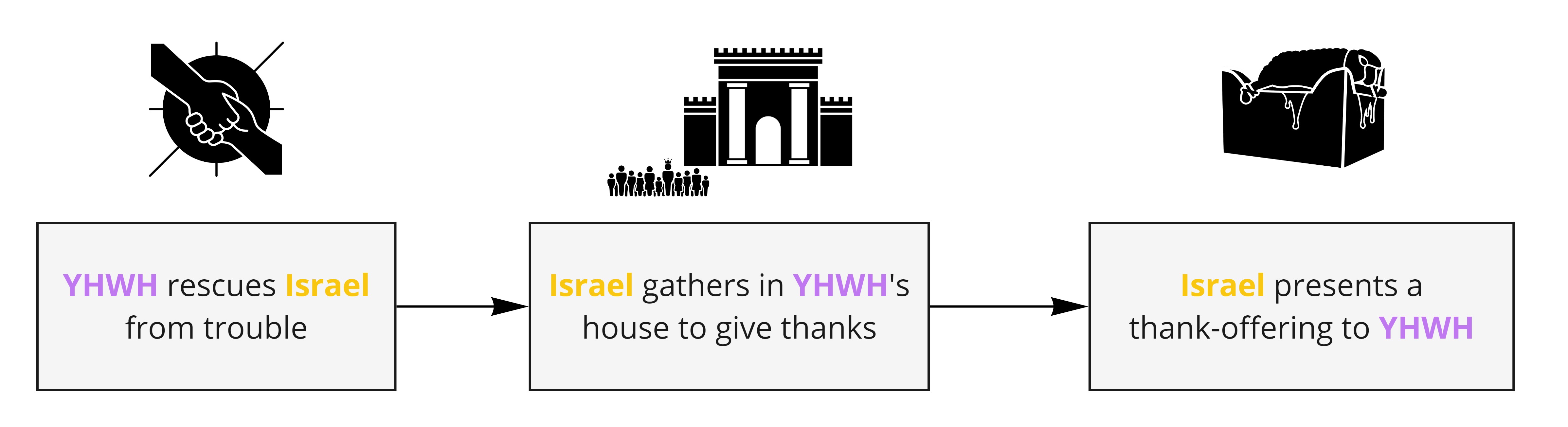

Activity
Act out this narrative as a team.
Suggested roles:
- YHWH
- The people of Israel
- Enemies attacking Israel
- A priest (for the thank offering)
Suggested steps:
- Enemies attack Israel.
- Israelites would go to Jerusalem to give thanks.
- They gather in the Temple.
- There’s a ceremonial entrance through the Temple gates.
- Songs of thanksgiving (vv. 4-5).
- Presentation of a thank-offering on the altar.
C. A Focus on Imagery
Although the shepherd imagery is only explicit in a single line (v. 3c), it is central to the psalm's structure and message. Verse 3 is "the heart of the psalm", which we will learn more about shortly. But let’s explore this image of YHWH as shepherd.
Suggested questions for the team
Do we have shepherding in our area? Are our people familiar with the idea? If we use the explicit metaphors of ‘shepherd’ and ‘flock’ in our song, are people going to know what those mean?
In what ways/aspects is YHWH like a shepherd?
If the team hasn’t already mentioned them, here are the points of comparison between YHWH and a shepherd: YHWH possesses his people, leading them to safety and sustenance and protecting them from enemies. He also allows his people to endure pain when necessary, for his and their sake.
If at all possible, we want to preserve the shepherding imagery, as it is repeated throughout the Bible and is central to its message. If our culture is unfamiliar with the idea, let’s explore some ways we might help them to understand it (perhaps through footnotes or drawings/photos in the written translation; or inserting short, natural-sounding explanatory phrases into the translation itself).
D. Walk through the psalm, itself
Display/project or print out the following diagram, and walk the team through it. The first column on the left shows the verse numbers, the next column shows the main sections of the psalm, the next shows the subsections within each section (along with a summary of the content), and the last column contains an icon that visually summarizes the content.
| v. 1a A psalm for a thank offering. | Superscription | |||
| v. 1 Shout joyfully to YHWH, all the earth! | Celebrate the Shepherd | Serve with joy! Enter with singing! |
 |
joy |
| v. 2 Serve YHWH with joy! Enter before him with exultation! | ||||
| v. 3 Acknowledge that YHWH, he is God. He has made us, and we are his, his people and the flock of his pasture. | YHWH is God, and we are his flock! |  | ||
| v. 4 Enter his gates with thanksgiving, his courts with praise. Give thanks to him! Bless his name, | Enter with thanksgiving! Bless his name! |
| ||
| v. 5 for YHWH is good, his loyalty is forever, and his faithfulness continues through generation after generation. | For He Is Good! | For YHWH is good, loyal, and faithful! |  |
confidence |