Psalm 100 Academics
His Joyful Flock
Psalm 100
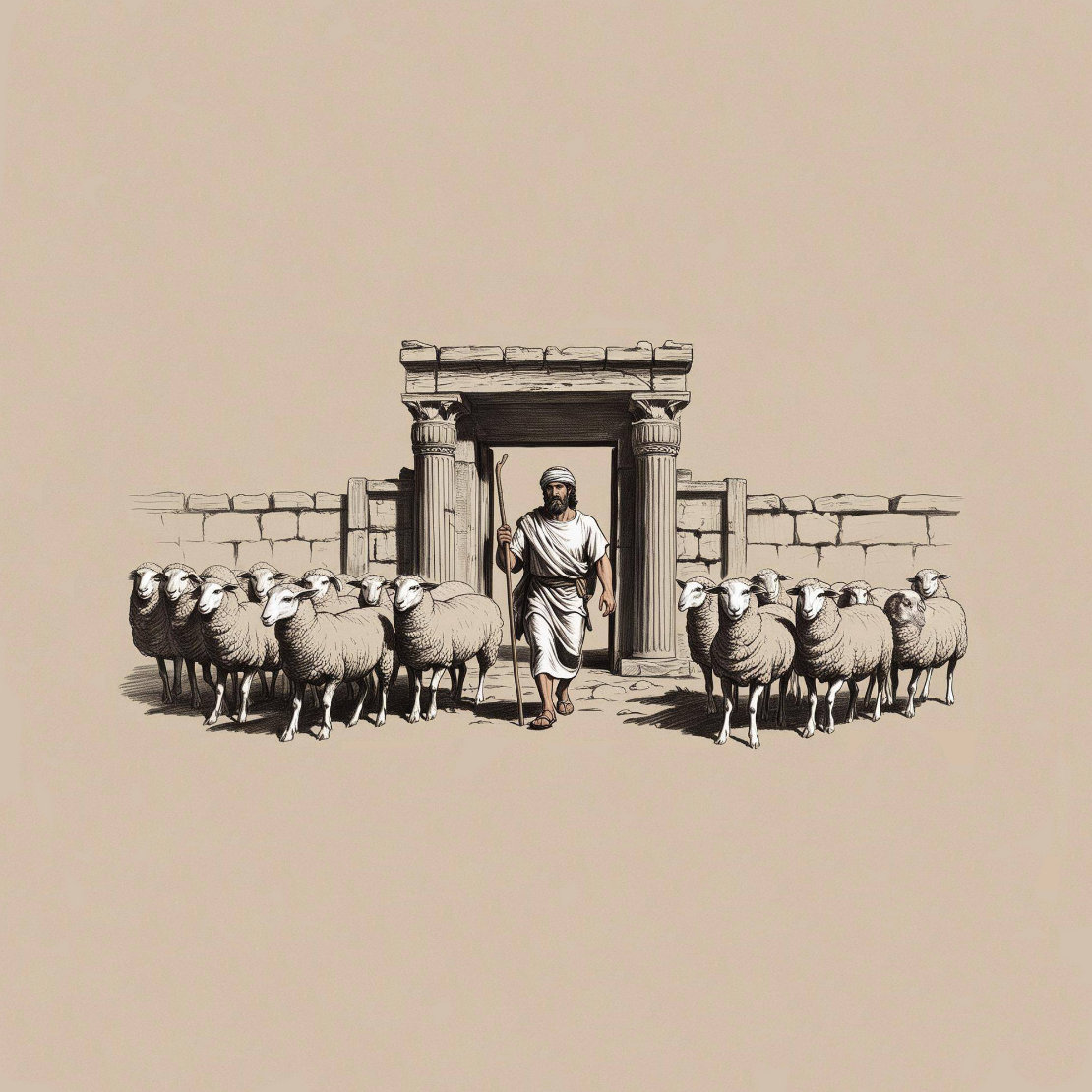
Guardian: Oobie Weinberg
Academic Resources
Explore our academic Psalms resources for Psalm 100, including our Layer-by-Layer analysis, select Exegetical Issues, and Overview Videos.
Overview 
- This page will introduce and provide orientation to Psalm 100 as a whole. It covers the message, structure, background and participants of the psalm.
Layer-by-Layer Analysis 
- The heart of our process is our layer-by-layer exegetical analysis, where we unfold the semantics, story behind, discourse, and poetics of each psalm.
Welcome to the Layers Page for Psalm 100
On this page you will find our layer-by-layer resources.

Grammar & Semantics
Semantics is the study of how language is used to represent meaning. The goal of semantic analysis is to understand the meaning of words and how they relate to each other in context. Our Semantics analysis consists of the following sub-layers:
- Grammar & Textual Criticism
- Lexical Semantics
- Phrase-Level Semantics
- Verbal Semantics

Story Behind
The Story Behind the Psalm shows how each part of the psalm fits together into a single coherent whole. Here, we analyze the meaning of sentences and larger units of discourse, up to and including the entire psalm. This also include historical background and figurative imagery.

Discourse
Our Discourse Layer moves beyond semantic-level meaning, and analyzes features of the text dependent on the speaker, addressee, and macrosyntax.

Poetics
Exploring the Psalms as poetry is crucial for understanding and experiencing the psalms and thus for faithfully translating them into another language.
Verse-by-Verse Notes 
- Explore the psalm verse-by-verse and section-by-section.
Psalm 100 Exegetical Issues 
- These issues examine the top three tough questions for each psalm, explaining different scholarly interpretations, and offering our perspective.
The commands go out to "all the earth", but the crowd actually standing at the temple is Israel. Israel is the real audience; "all the earth" declares that YHWH deserves the glad shouting of everyone alive. Most languages must address someone, so follow the Hebrew and address all the earth, using a word that can include people ("all the peoples of the earth"), not just land or territory. Then keep the "we" of verse 3 for Israel: it is inclusive of the speaker and the congregation, but it does not extend to the nations. Answer the question the same way in both places.
The written consonants read לֹא, "not" ("he made us, and not we ourselves"); the traditional reading is לוֹ, "to him" ("and we are his"). The two sound the same. We follow לוֹ: it supplies the subject that "his people and the flock of his pasture" needs, and it echoes the covenant formula "I will be their God and they will be my people". Teams comparing versions will meet the other reading in KJV, NKJV and NASB. Where the community knows that reading, a footnote is worth considering.
This is the only line in the psalm that sets the personal name beside the general word for a god, and the doubled subject means YHWH alone, and no god of the nations, is God. The two terms must stay distinct: if one word does duty for both, the line becomes "God is God" and the claim disappears. Use the team's settled rendering of the divine name, and find some means (a particle, a cleft, stress in performance) to bring out the exclusiveness.
"He has made us" is not the creation of the world. It is YHWH forming a nation out of slaves in Egypt, so where a language separates creating from nothing and making or forming, choose the second. The "us" who were made are the same "us" who belong to him and are his flock. The flock is the psalm's one picture. Where shepherding is unfamiliar, render the sense ("the flock he cares for", or simply "the people he cares for"), and make the comparison explicit if the language needs it ("we are like his flock").
Verses 1b–4 are a chain of seven commands, each first in its line, arranged around verse 3. In many languages bare commands to a large gathering sound rude or comic. Decide once, for all seven together, whether to use a polite form, a hortative ("let us…") or politeness particles, so the chain still sounds like one series. The commands are not all of one kind: "shout joyfully" in 1b is an imperative that asserts YHWH's worth, the shout that greets a king, so the rendering must carry both loudness and gladness. A translation that sounds solemn rather than glad has missed the mood.
The superscription places the psalm in a temple ceremony: the toda offering brought after YHWH had rescued his people. We read לְ as "for" (the psalm's purpose), not "of" (its content). Be careful with local words for religious offerings. A word for an offering that earns merit, turns away anger or feeds the ancestors says the wrong thing here: the toda answers help already given. Where the obvious word implies the worshipper gains something, use a descriptive phrase such as "an offering to say thank you to God".
To bless YHWH is to speak well of him: what is to be said is named in verse 5, his goodness, loyalty and faithfulness. A direct equivalent often fails. In some cultures a junior may not bless a senior; in others, blessing means handing over goods. Where either problem arises, "praise" is the safest rendering. "His name" stands for YHWH himself, so "bless him" is acceptable where "bless his name" is unnatural.
"Give thanks to YHWH, for he is good, for his loyalty is forever" was one of the best-known refrains of Israel's worship. Psalm 100 splits it: "give thanks to him" in 4c, the rest in verse 5. Draft the two halves together and check them against each other, and against the same saying elsewhere in the Old Testament. The opening "for" of verse 5 is the hinge of the psalm, making it the reason for every command before it, so that link must not be lost. חֶסֶד (loyalty: covenant commitment that does not fail) and אֱמוּנָה (faithfulness: trustworthiness shown in action) need the renderings used throughout Scripture.
Psalm 100 Videos 
- There are no videos currently available for this psalm.