Psalm 1/TPN/Overview
The following gives a basic Overview of the Psalm, answering the following questions:
- Title – what title best describes this unique psalm?
"Happy is the one" - Purpose – why was this psalm written?
To persuade the hearer that following YHWH's instruction is worthwhile. - Content – in summary, what is said in this psalm?
It is not the wicked, but the one who follows YHWH's instruction who is "happy." This is because YHWH cares for the way of righteous people, and the wicked's way will come to an end. - Message – what is the main point or theme?
In the end, it's those who follow YHWH's instruction who will flourish.
Every psalm has a coherent story behind it. However, many psalms are not written in typical "story" format, with a clear beginning, middle, and end. Here, we attempt to understand the story and background that prompted the psalmist to write.
Story Behind

- People declare someone to be "happy" (אַשְׁרֵי) when they admire that person's condition and consider it to be desirable (cf. Janzen 1965, 215-226; SDBH). For example, when the Queen of Sheba saw the wealth and wisdom and King Solomon, she exclaimed, "Happy (אַשְׁרֵי) are your men! Happy are your servants, who continually stand before you and hear your wisdom!" (1 Kgs 10:8, ESV).
- When wicked people flourish, others are tempted to declare them "happy." For example, Malachi (which occurs immediately before Ps 1 in the order of the Hebrew canon) says, “You have said, ‘It is futile to serve God. What do we gain by carrying out his requirements and going about like mourners before the Lord Almighty? But now we call the arrogant blessed. Certainly evildoers prosper, and even when they put God to the test, they get away with it’” (Mal 3:14-15, NIV; cf. Jer 12:1; Ps 73).
- YHWH is the judge of all the earth (Gen 18:25), and the job of a just judge is to acquit the righteous/innocent (צַדִּיק) and condemn the wicked/guilty (רָשָׁע) (see Deut 25:1).
“In winnowing, grain is threshed in order to separate the kernel of grain from the husk and straw. The mixture is thrown into the air with a winnowing fork or shovel. The wind blows the light husksaway, the heavier straw falls near the edge of the threshing floor, and the grain falls back to the floor to be collected. Both the light husks and the heavier straw are referred to in the words translated ‘chaff’ in the Bible” (Ryken et al. ed. 1998, 136).
- The place of YHWH's life-giving presence is depicted as a garden paradise (Gen 2; Ezek 47:12) in which the righteous grow like trees (Pss 52:10; 92:13-15; cf. Creach 1999).
The theme of the story behind Psalm 1 can be summarized as 'The way of the wicked will come to an end.' At the beginning of this story, wicked people live alongside righteous people, and the wicked people seem to flourish. That is why many people call the wicked people "happy" or "blessed." But the psalmist calls the righteous people the "happy" ones, because there will be a time when judgment comes. YHWH will separate the wicked people from the righteous people and remove the wicked people from the land. Then, the righteous people will alone possess the land, and they will flourish like trees in YHWH's garden.

Knowing the layout of the psalm by sections helps us to understand the progression of thought as the poem progresses. The picture below shows the main “chunks” or pieces of the poem. Verse numbers appear on the left. The second column has a title for each section. The large third column contains a brief summary of the section’s content. As you read through the content column, you will see important words and ideas highlighted in similar colors. The icons on the right may be used as memory aids.

Progression–what is the flow of thought and emotion as the poem progresses?
Psalm 1 compares two kinds of people and how they relate to YHWH: The first part (verses 1-3) focuses on "the happy" person. This person avoids the way of sinful people, and is devoted to YHWH's instruction. Therefore, this person flourishes like a tree. The second part (verses 4-5) deals with "the wicked" people. When the final judgment comes, these people will be blown away like chaff and will not stand with the righteous people. The third part (verse 6) focuses on YHWH as the reason for the two different results that the righteous people and the wicked people experience. YHWH cares for the way of righteous people, but the way of wicked people will come to an end.
Part of poetry is communicating emotion. Each section, and even each verse, can contain a number of different emotions. Here are the main emotional themes of each section:

The psalm begins with the emotion of admiration for the one who does what is right (verses 1-3). The psalmist then expresses contempt for the wicked (verses 4-5). The psalm ends with the emotion of confidence that YHWH will allow the righteous to stand and will destroy the wicked.
In poetry, it is important to keep track of who is speaking, who is the audience, and what it is that the speaker is trying to do with his words. In the chart below, the left-hand column identifies the speaker, the right-hand column identifies the audience, while the middle column tells what the speaker is trying to do with his words (his speech acts) in each section.

Poetics–what kinds of artistic beauty did the psalmist incorporate into the poem to reinforce its message? (See Poetic Features video and layer for more details.)
-
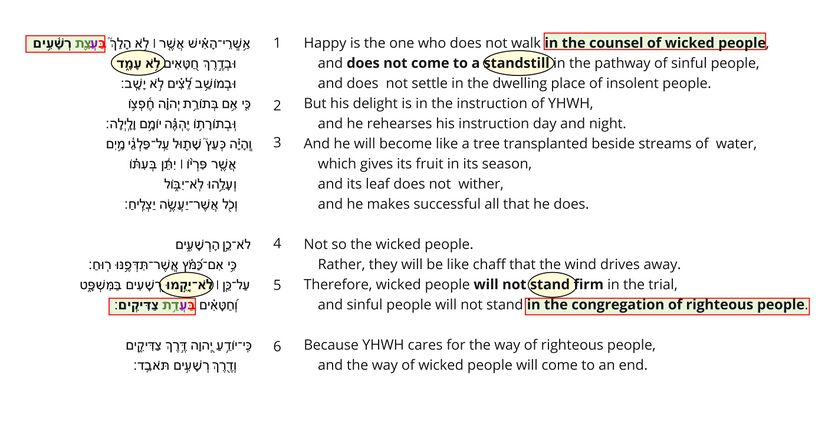
No Standing
There are several similarities between verses 1 and 5:
- Both verses contain negated verbs that mean stand.
- In Hebrew, the phrase in the counsel of wicked people in verse 1a is similar in structure and sound to the phrase in the group of righteous people in verse 5b.
- Thus, just as the righteous person does not stand with wicked people (verse 1), neither will wicked people stand with righteous people (verse 5).
Day-and-Night Meditation
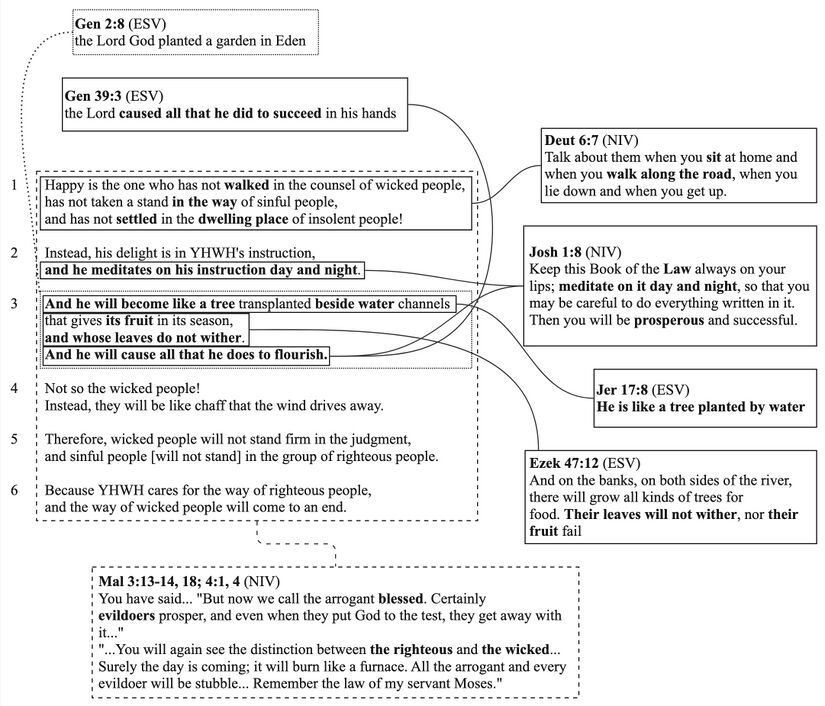
Psalm 1 alludes to multiple passages in the Old Testament: Language from Joshua 1:8 includes "meditating" on YHWH's "instruction" "day and night" (verse 2), the "way" (verses 1, 6), and "make successful" (הצליח, verse 3). The description of the righteous person as a tree (verse 3) draws from Jeremiah 17:8 and Ezekiel 47:12. Verse 3 recalls Joseph. The phrase "and he will cause all that he does to flourish" echoes the description of Joseph in Genesis 39:3, and Joseph is also described as a fruitful tree by a water source in Genesis 49:22. The language of "walking," "way," and "sitting/settling" in verse 1 recalls Deuteronomy 6 and the command to love YHWH with one's whole being. The Psalms follow immediately after Malachi, and Psalm 1 picks up many of the themes from the end of Malachi (such as "blessedness," righteous vs wicked, chaff, Torah, coming judgment). What is the effect of these allusions? The psalmist did not randomly choose these OT passages. The choice of OT passages is strategic. Psalm 1 alludes to the first and last books of the Torah (Genesis and Deuteronomy), the first and last books of the prophets (Joshua and Malachi), and the first book of the latter prophets (Jeremiah). Psalm 1 provides a guided tour through YHWH's instruction in the Law and the Prophets. The author gives the essence of their teaching about YHWH's instruction in a short but powerful poem.


Prominence–what words, phrases, or ideas are most important in this psalm? It is also important to consider how the author chose to draw attention to certain parts of the psalm. Here are the parts of the psalm that we believe are most prominent, and thus should be most prominent in a performance of the psalm.
The Climax of Flourishing
The most prominent part of the psalm is the final line of the first section. In particular, there is emphasis on the final Hebrew word of this line: he will cause to flourish (יַצְלִיחַ). This word can refer to success on a journey (Joshua 1:8) as well as to the flourishing of a plant (see Ezekiel 17:9), and both of these images are prominent in Psalm 1 (journey imagery in verses 1 and 6; tree imagery in verse 3). So, the word unites the two most important images in the psalm. And, the subject of the verb is ambiguous. Is it the righteous person, the tree, or YHWH? See The Grammar of Ps 1:3d. In effect, the word ties together the flourishing of the tree, the flourishing of the righteous person, and YHWH as the cause of all flourishing. Finally, the word helps connect Psalm 1 to both Joshua (Joshua 1:8) and the Joseph story in Genesis (Gen 39:3, 23). Both of these men were powerful examples of faithfulness and flourishing under YHWH's care.

Translation Tips: Psalm 1 as a Whole
These are the elements that we believe are most helpful to keep in mind during both drafting and checking translations, to help verify that the translation or performance is accurate beyond just a word- or verse-level; just as important is accuracy on the level of a whole. Additionally, these are elements that will guide decisions about performance in oral translations, songs, poems, or other kinds of art based on this psalm.